What’s Happening With Bull Trout on the Lower Deschutes?
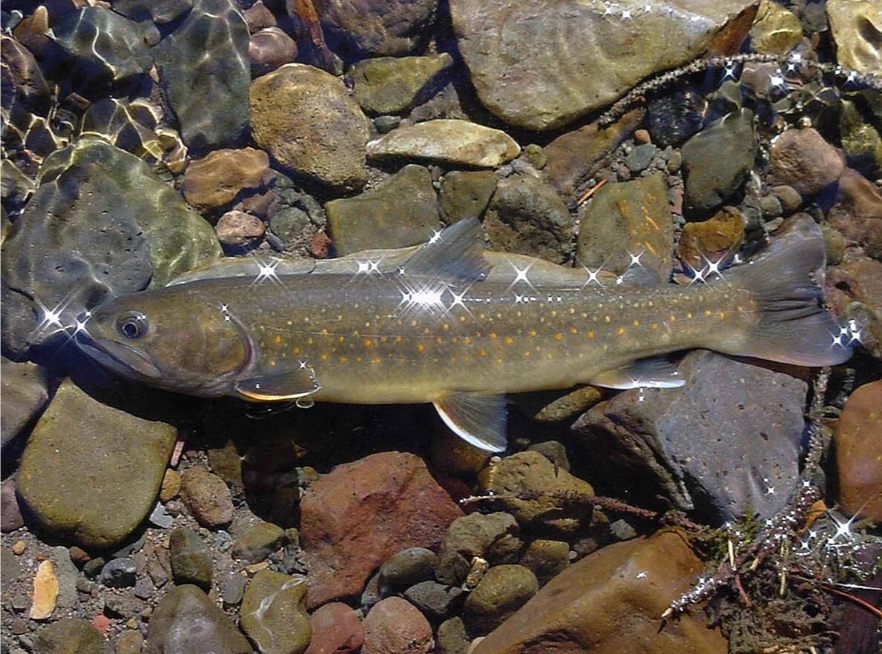
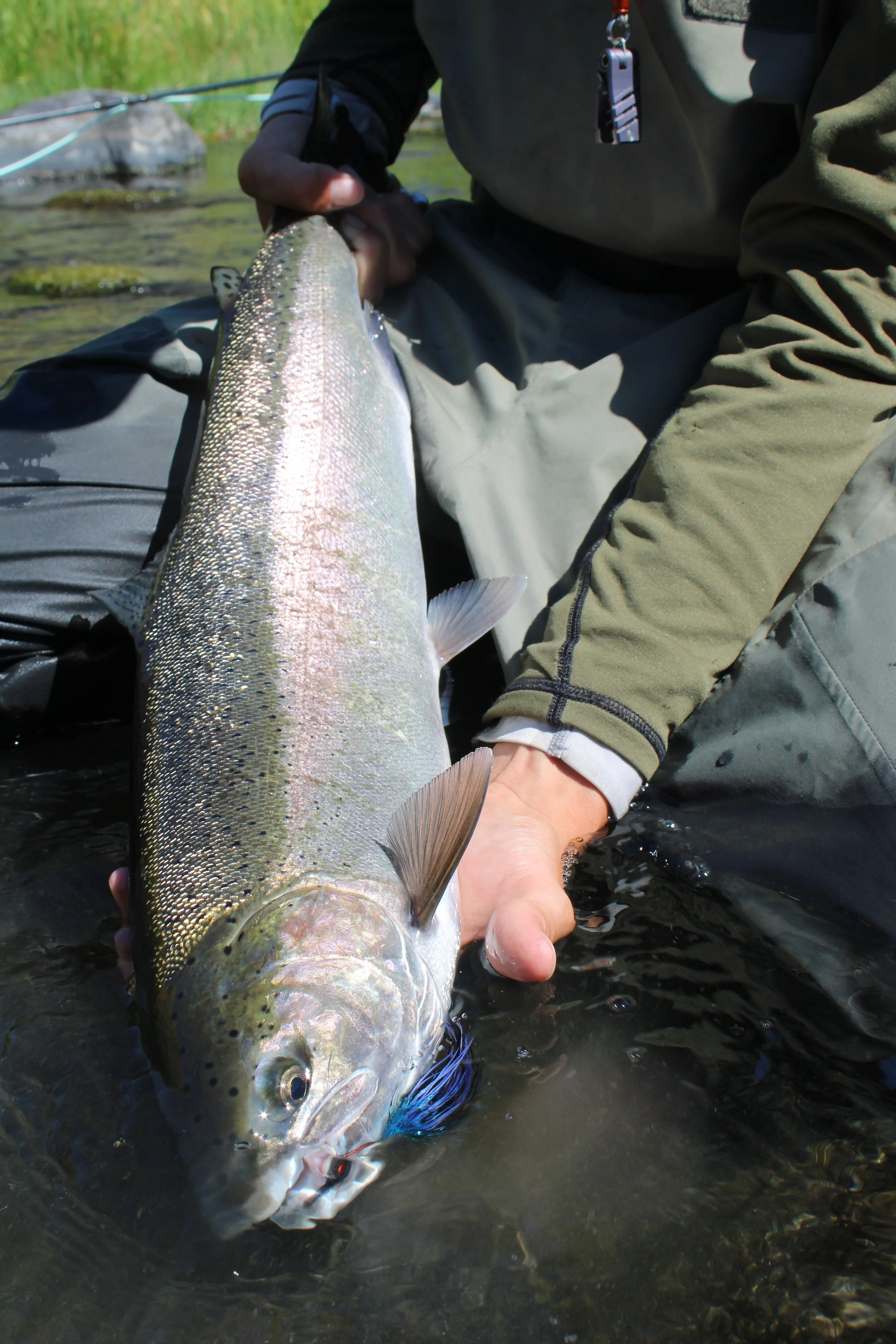
Bull trout with bling: part of the char family, bull trout once thrived throughout the Deschutes Basin.
Lower River Not Managed for Bull Trout Existence
You’ll find them in the high, cold water of western streams. You’ll know them by the white leading edges of their fins, the white, orange, yellow and salmon-colored bright dots on their olive-hued skin.They can grow up to 30 inches in length. They’re wiley, strong, and once inhabited much of the entirety of the Deschutes Basin.
Bull trout (Salvelinus confluentus) are a member of the char family. They’re also listed throughout the lower 48 states as threatened under the Endangered Species Act. The river systems bull trout inhabit require the superlative version of the fluvial four C’s–cold, clean, complex and connected. According to the U.S. Fish and Wildlife Service, they do best in water temperatures between 50-57 F., and are “rarely found in water that exceeds 59-64F.”
In much of the state of Oregon, the administrative rules for stream management where bull trout are present include temperature standards that apply from August 15th to May 15th. During this time, rivers draining the central and northern Cascades must not exceed the 7-day maximum temperature of 53.6 F. The exception to these rules: the lower Deschutes River.
Deschutes Bull Trout are managed through a separate rule written in 2003, as PGE was scheming to design and build the Selective Water Withdrawal Tower and apply for a new operating license for the Pelton-Round Butte Project.
Extinct in the Upper Basin, Threatened Elsewhere
The temperature exception could be a curious coincidence, or a quiet acknowledgement that operation of the SWW would raise temperatures in the lower river. Either way, presently, bull trout are still listed as threatened under the ESA. Somehow, a few of them are still eking out a living in the lower Deschutes and three of its tributaries, despite the fact that PGE does not manage the lower river for their existence. Not adhering to good science, law and policy is an odd choice, given the trajectory of bull trout in the Deschutes Basin over the past 70 years.
According to ODFW, the Deschutes bull trout SMU (Species Management Unit) comprises 8 distinct populations, three of which are extinct. (Upper Deschutes Basin, Crescent Lake and Suttle Lake bull trout are no longer with us.) Of the five that remain, three are confined to the lower Deschutes between the re-regulating dam and Sherar’s Falls. The Whitewater, Shitike and Warm Springs bull trout SMU’s, according to ODFW, don’t pass all the metrics that indicate a healthy population.
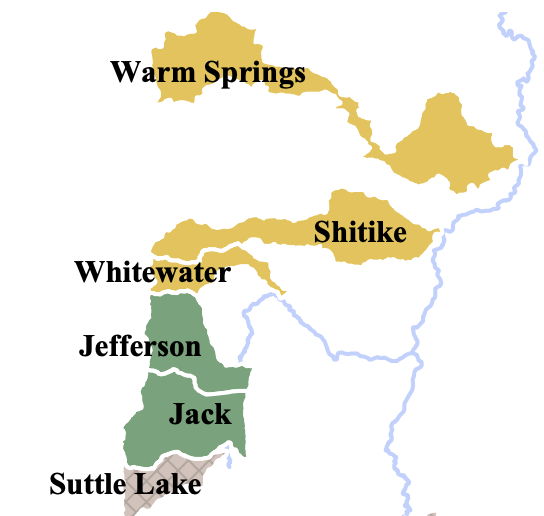
The five distinct bull trout populations of the Deschutes Basin. Green indicates healthy, viable population, while yellow, below the Pelton-Round Butte Complex, indicates potential trouble. Suttle and Crescent Lake as well as the entire upper basin populations are extinct.
The construction of the Pelton-Round Butte dams transformed a river system that may have been Oregon’s finest example of those four C’s (cold, clean, complex and connected). The first hit was on the last C: after dam construction, the Deschutes was no longer connected to the upper basin.
In Montana and Idaho, bull trout have been tracked over 150 miles to reach spawning grounds. This suggests a bull trout survival strategy that depends on access to vast reaches of intact watersheds. Cutting off the ability to widely peregrinate may risk genetic isolation of specific populations. As a possible example, the Whitewater SMU, ODFW reports, now has fewer than 60 adults, which does not pass the agency’s population viability standard.
To make matters more dire, the introduction of brook trout in Warm Springs, Shitike, and Jack Creek drainages has produced some evidence of hybridization. Bull trout and brook trout can mate and produce offspring–but their progeny often exhibit signs of poor health, including sterility.
Snacking on Steelhead, Sockeye and Chinook?
By contrast, the Metolius River and Lake Billy Chinook are bright spots for Deschutes Basin bull trout. (These waters harbor the Jack and Jefferson SMU’s, the more robust of the remaining five.) Lake Billy Chinook is one of only two places in the country where you can catch and keep one. It’s become a popular fishery, and the year-round, sub-55F water temperatures in the Metolius River and reservoir arm provide some of the best bull trout habitat in the state. Yet viable numbers of well-fed bull trout may be a liability for PGE’s salmon and steelhead reintroduction program.
In 2024, at the fish collection facility adjacent the SWW, 2,000 bull trout were trapped. Bull trout are voracious predators of other fish. The U.S. Fish and Wildlife Service recognizes the problem: “It is worth noting that when a ‘trap and haul’ mitigation approach is used in lieu of providing volitional passage, there is a risk of adult bull trout preying upon juveniles and other species of concern.”
PGE commissioned a trio of USGS researchers who identified this issue at the SWW. In 2020, they wrote: “When bull trout-size fish were present, larger percentages of all three smolt-size fish were absent, which has been observed at other Surface collectors…Increased abundances of bull trout-size fish during periods of increased smolt-size fish presence suggests that the SWW is being used as a prey ambush location when prey densities are elevated.”
Collecting outmigrating juvenile reintroduced salmon and steelhead may well provide bull trout with a food source in a deliciously predictable and confined space, and adds to the substantial list of reasons why survival for reintroduction fish through the reservoir is so alarmingly low.
Out of the Reservoir, into the Lower River
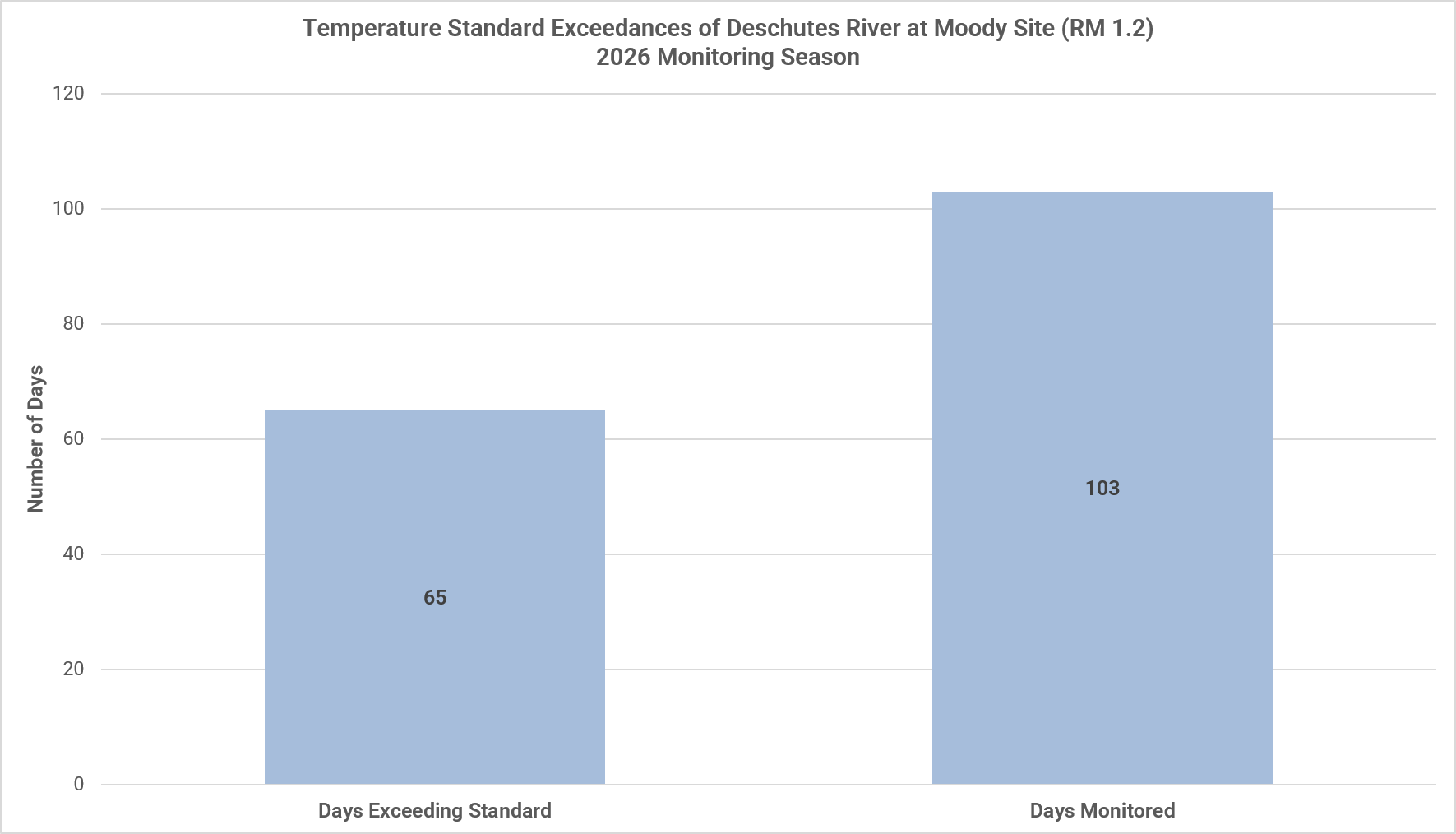
Despite not managing the lower river for bull trout, PGE still traps them at the SWW and releases some of them into the lower Deschutes. Whether this is done in part to mitigate for predation in the reservoir, or in pursuit of the original goal of reconnecting the upper and lower basin for these fish, the outcome is that some perfectly healthy bull trout above the dams are trucked to marginal habitat in the lower river where less stringent water quality standards aimed at protecting rainbow trout, steelhead sockeye and Chinook are still routinely violated.
The odds of augmenting the relatively meager bull trout population in the lower river this way look to be quite long. The 4 C’s of lower Deschutes River bull trout management might more accurately be cited as cut-off, confused, crass and compromised.
More From The Blog
Subscribe the the DRA Newsletter
The Deschutes River Alliance is your focused voice to protect the lower Deschutes River, its cold water flows and the fish and wildlife that are sustained by them. We send regular emails with important data and news about the lower Deschutes River. We will not sell your contact information to others.
How to Support the DRA
Everyone wants clean, healthy water in the Deschutes River. Oregonians cherish our clean and healthy waterways to provide drinking water, wildlife habitat and recreational activities. The lower Deschutes River is a federally designated Wild & Scenic River, and a national treasure. It must be protected for the environmental and economic health of Central Oregon. By working together we can return the lower Deschutes River to full health.