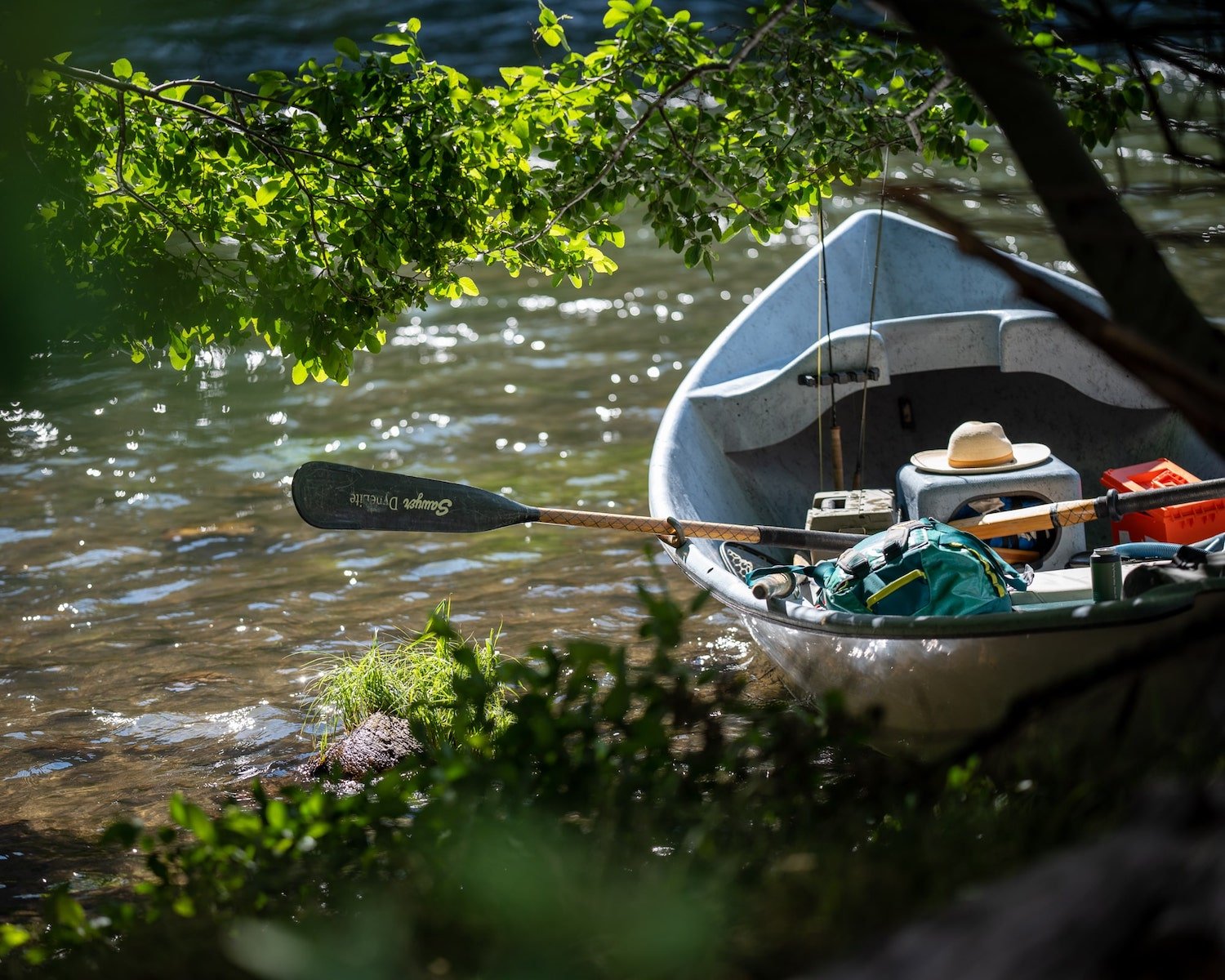
Bug of the Month: March Brown
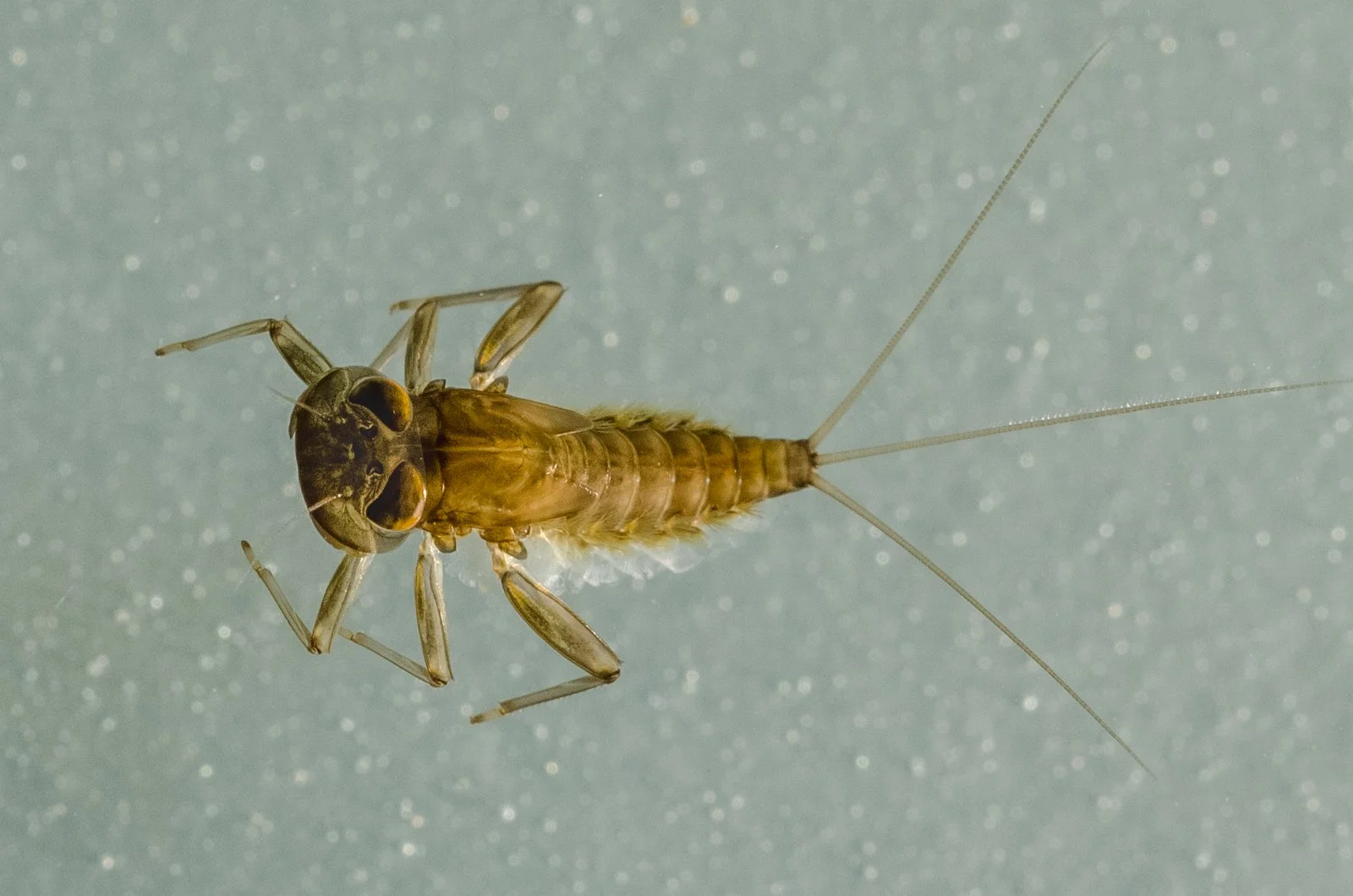
March Brown nymph. Pay attention to this bug, as the trout surely will. Photo by Rick Hafele.
Big Mayfly Emergence Signals Spring
By Hannah Camel
Welcome back to the Deschutes River Alliance’s Bug of the Month blog series. Each month throughout 2026, we’re spotlighting an aquatic insect that plays a critical role in the lower Deschutes River ecosystem. Every feature explores the insect’s life history, preferred habitat, seasonal timing, and abundance, alongside insights from DRA’s water quality and macroinvertebrate monitoring data. For anglers, we also include guide-approved fly patterns and practical tips on when, where, and how to fish both nymphs and dry flies that imitate each featured insect.
This month, we’re highlighting the March brown; one of the first large mayfly hatches of the year to emerge in strong, fishable numbers. As winter loosens its grip on Western rivers, the arrival of March browns signals a seasonal turning point. For many anglers, this hatch marks the true beginning of spring fly fishing, bringing with it consistent opportunities to target rising trout after months of cold, quiet water.
Life History and Habitat
The western March brown (Rhithrogena morrisoni) belongs to the family Heptageniidae, one of several families within the order Ephemeroptera, commonly known as mayflies. In the western United States, Heptageniidae includes 11 genera and about 47 described species, with 134 identified across North America (number of species frequently changes as new taxonomic information becomes available). But don’t worry—you don’t need to memorize them all streamside. Within the genus Rhithrogena, there are more than 150 species worldwide, but only a few stand out as especially important in this region. These include R. hageni (western black quill), R. undulata (small western red quill), R. robusta (robust flat-headed mayfly), and stealing the spotlight this month, R. morrisoni, the western March brown. While the taxonomy can get a bit tangled, the takeaway is simple: when you see a big, clinger-style mayfly coming off in early spring, there’s a good chance you’re looking at a March brown. When that happens, it is worth paying attention, because the trout certainly will be.
March brown hatches are a hallmark of mid-spring, but their timing can shift quite a bit from year to year. Like most aquatic insects, their emergence is closely tied to water temperature and influenced by winter conditions. After a mild winter, you might see the first bugs as early as February. In years with colder conditions or late-season storms, the hatch is often pushed back into March or even early April as cooler water delays emergence. On the lower Deschutes, the name “March brown” can be a bit misleading. While March may come and go without much sign of them, these insects are right on schedule. They tend to emerge when water temperatures reach about 48–49°F, with peak activity kicking in as temperatures approach 50°F. In most years, that sweet spot lines up more closely with April, when the hatch can really come alive.
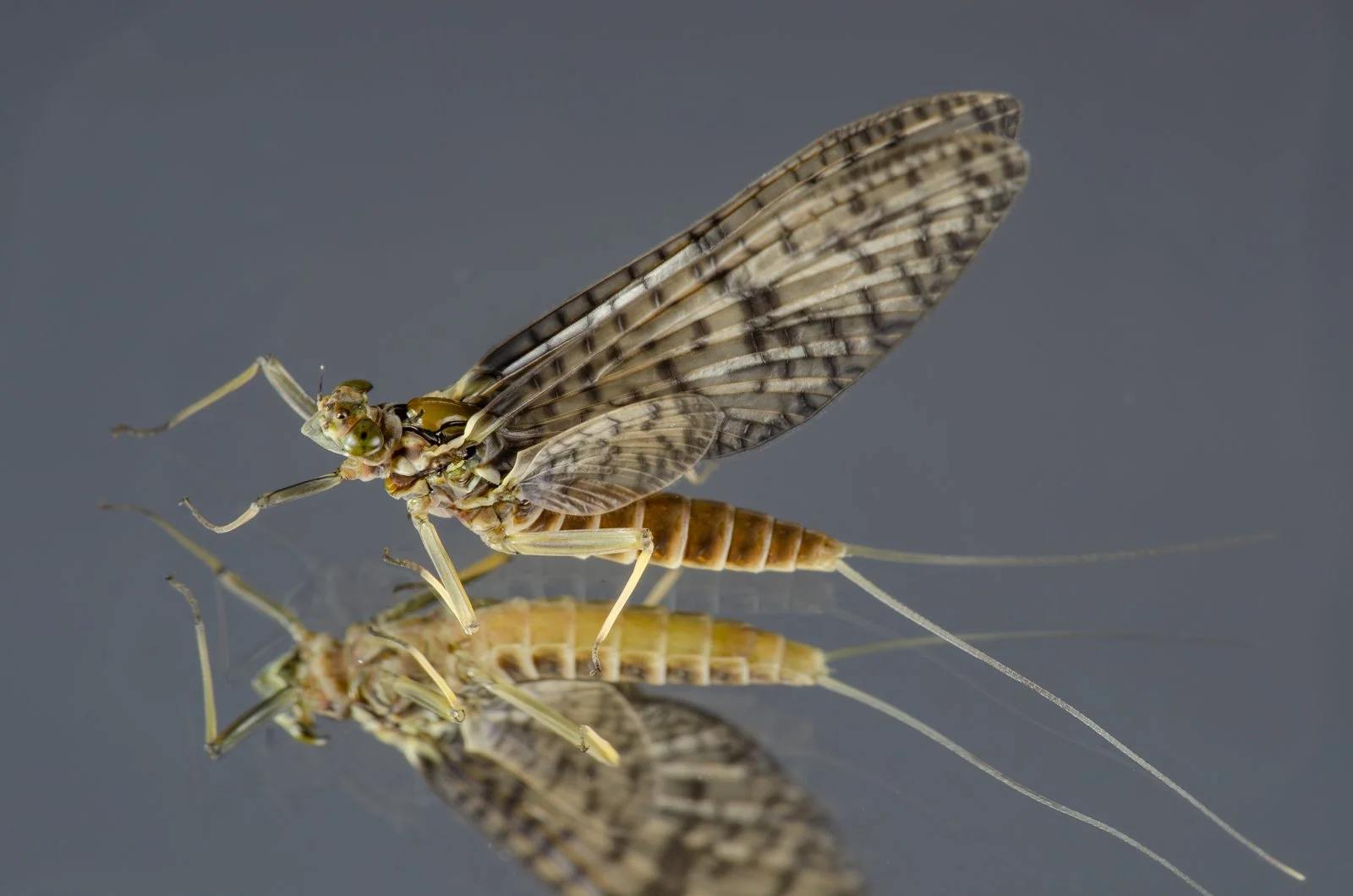
March Brown Dun, done. Photo by Rick Hafele
Hatches typically occur during the warmest part of the day, with the most consistent and prolonged activity happening under cool, overcast skies. Add a light rain, and conditions can be ideal. On these days, duns often begin emerging around midday and continue into the late afternoon, sometimes lasting until 4 or 5 p.m. On bright, sunny days, the timing is similar, but the hatch is much shorter, often condensed into a 30-minute to one-hour window. Even so, these shorter windows can still produce dense, heavy emergences. Another interesting trait of March browns is their occasional “echo hatch” in the fall. On some rivers, a smaller second emergence can occur in September. These March browns are typically smaller than their spring counterparts and follow a similar pattern, emerging during the warmest part of the day over a few hours.
Like all mayflies, March browns move through three distinct life stages: nymph, dun, and spinner. The nymph stage is where they spend the majority of their lives, and it is also where they are best adapted to their environment. March browns are classified as clingers, built to thrive in fast, turbulent water. Their flattened bodies and broad, shovel-shaped heads allow them to stay tight against rocks and woody debris, holding position in the thin boundary layer where current is reduced by friction along the streambed. They are most commonly found in riffles, but it’s not unusual to see them in moderate-flow glides and runs adjacent to swift water, especially as they near maturity. Nymphs often tuck themselves into small crevices between or beneath rocks for protection. During low-light periods such as early morning, evening, or overcast days, they move onto exposed rock surfaces to graze on diatoms and algae. While they are well adapted to holding on, this feeding behavior increases their exposure to the current, and more individuals get swept into the drift. Once dislodged, they are not strong swimmers and tend to tumble along the bottom until they can regain contact with the substrate.
March brown nymphs are fairly easy to recognize. They have large, plate-like gills, with the first and last pairs overlapping beneath the abdomen to form a distinctive suction-like disk. They have three tails about as long as their body, with mature R. morrisoni showing noticeably pale or whitish tails. Their eyes are positioned on top of the head rather than on the sides, and their coloration ranges from olive-brown to dark reddish-brown with a lighter underside. Most measure between ¼ to ½ inch in length. March brown nymphs typically take about seven months to mature. In the weeks leading up to emergence, they begin to shift out of heavy current into slightly slower water along the margins, above or below riffles, where they prepare to transition into the dun stage.
When it is time to emerge, March brown nymphs can reach the surface in a few different ways. They may escape their nymphal shuck as duns while the nymph is still attached to the bottom. The duns are then buoyed to the surface by bubbles of exuded gasses trapped in the folds of the wings. Others swim up as nymphs and complete the transition within the surface film. In either case, emergence is typically quick and efficient, so cripples are relatively uncommon during this hatch. That said, early-season conditions can change the pace. On colder days, newly emerged duns may linger on the water longer than usual, sometimes drifting twenty feet or more before taking flight. This extended window can create excellent feeding opportunities for trout.
March brown duns are fairly distinctive. They have two tails roughly the length of their body, and their head still shows the wide, flattened profile carried over from the nymph stage. Their wings are well developed, mottled brown in color, and feature a network of heavily branched veins near the leading edge, creating a darker shaded area. Body coloration ranges from light to reddish-brown or even purplish tones along the back, with a lighter underside that may appear olive, cream, or pale brown. Most duns measure between ¼ to 5/8 inch in length.
Roughly two days after emerging, duns molt into their final stage, the spinner. At this point, they are fully mature and ready to reproduce. Mating flights usually take place in the mid to late afternoon or evening, and males gather in swarms, often 40 to 50 feet above the water. Females enter these swarms, and mating happens quickly. Afterward, females typically rest on nearby vegetation while their eggs are fertilized. Once ready, they return to the water and deposit eggs by repeatedly touching the surface with their abdomen, releasing small clusters each time. After mating, March browns, like all mayflies, die very quickly, usually within a few hours to a day at most.
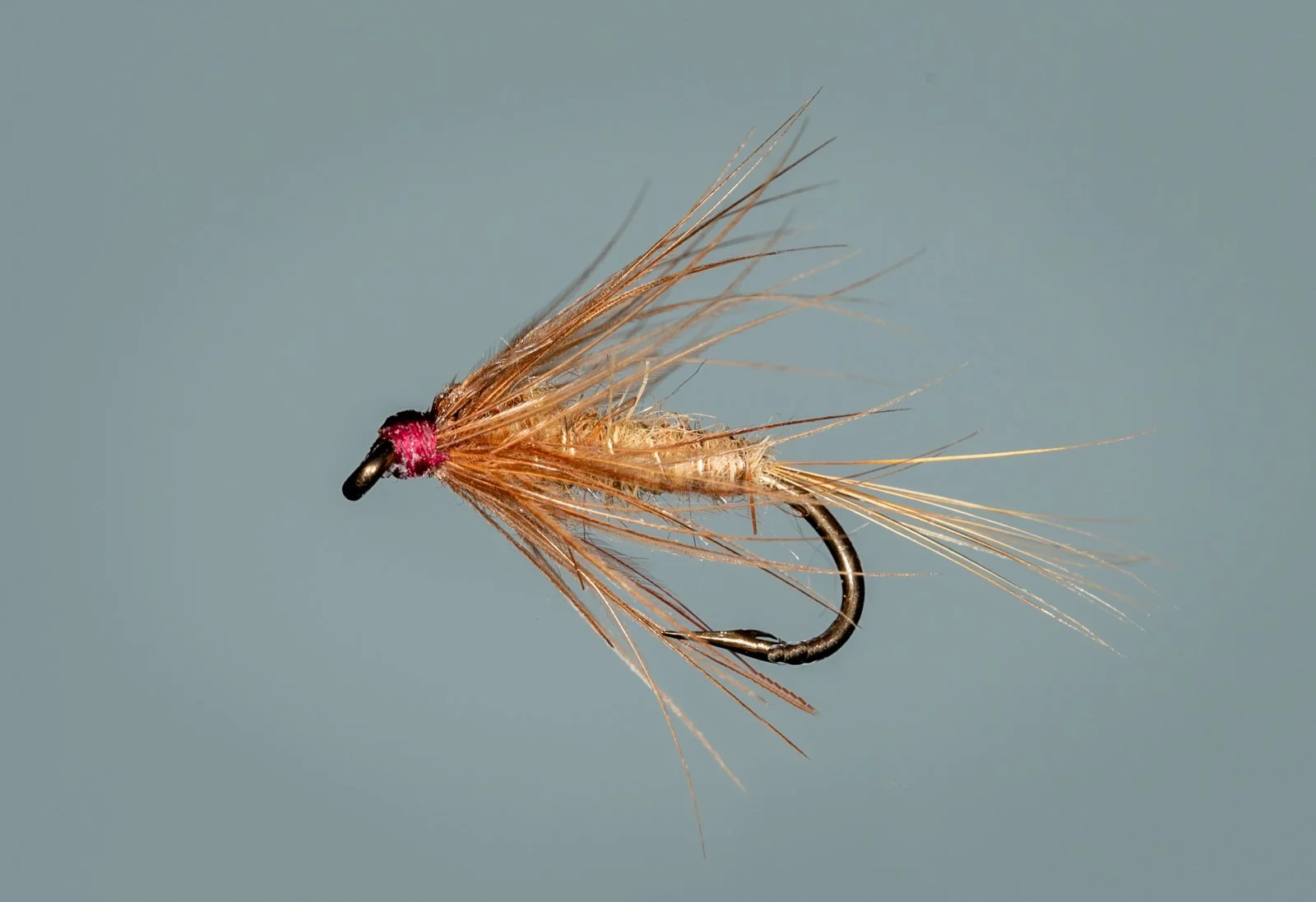
MB “flymph” Emerger pattern. You might try swinging one sub-surface and slow.
Digging Into the Data: DRA Macroinvertebrate Monitoring
Now that we’ve covered the basics of March brown life history, let’s examine what DRA’s macroinvertebrate monitoring data reveals about their presence and abundance in the lower Deschutes River.
Lab sampling identifies Rhithrogena to the genus level only, though Rhithrogena morrisoni is the species most likely present in the lower Deschutes. In 2025, spring samples from downstream sites—located upstream of the White River and near Macks Canyon—showed an average relative abundance of 0.67% (30.27 individuals/m²). No Rhithrogena were collected at the two upstream sites near Warm Springs and Kaskela. Fall sampling showed higher numbers, averaging 1.41% (123.29 individuals/m²) across three of the four sites, again with no individuals detected at Warm Springs.
Lower spring abundance is not unexpected, given that March browns are emerging during this period. However, the consistent absence of Rhithrogena at the Warm Springs site is notable. Since monitoring began in 2015, no individuals have been collected there in either spring or fall. In contrast, data collected prior to 2010, before the SWW began operating, indicates that Rhithrogena were present at upstream sites in relatively strong numbers. For example, samples from reaches comparable to Warm Springs (RM 90.4–99.9) showed averages of 189.3 individuals/m² in October 1999 and 12.11 individuals/m² in October 2001.
This shift may suggest that upstream conditions can no longer support Rhithrogena populations. While the limited amount of pre-tower data makes it difficult to draw firm conclusions about long-term trends, March browns are widely recognized as sensitive to changes in water quality. Across parts of the eastern United States and Canada, Rhithrogena have largely disappeared as fishable hatches in response to declining water conditions. This pattern serves as an important warning of what could occur in western rivers if water quality continues to decline.
MB Patterns and Fishing Tips
Understanding March brown habitat preferences, behavior, life stages, and hatch timing is essential when choosing the right fly—and knowing how, when, and where to fish it can make all the difference.
Nymph Imitations
When March brown nymphs are abundant, nymph patterns are most effective during the pre-hatch migrations of the naturals and as nymphs begin moving toward the surface. This window typically occurs one to two weeks before the main emergence. Most patterns fall in the size 12–16 range. Focus on shallow, rocky riffles and fast water early on, then shift to slower margins once emergence begins, as nymphs move into these areas to prepare. In either situation, fish an indicator rig with split shot and aim for a dead drift close to the bottom, since trout are still feeding subsurface. Adjust weight and depth based on conditions to keep your fly just above the rocks where naturals are found.
During the hatch, nymphing can remain highly effective. Remove the split shot and fish a lightly weighted nymph on upstream casts to rising fish or likely holding water. Use a slightly weighted nymph rather than one with a tungsten bead, as this will ensure it is fishing at the right depth to imitate an ascending nymph.
Using exact imitation is not necessary, and nymphs can be imitated with traditional patterns such as a pheasant tail. If tied with a slightly fuller-body, it will do well at capturing the color and widespread shape of natural nymphs. In faster water, a pheasant tail jig with a tungsten bead can help keep your fly down near the riverbed where feeding fish are keyed in.
Emerger Imitations
During a typical March brown hatch, more naturals are likely taken below the surface than on top, making emerger patterns especially effective. They are particularly useful on bright, sunny days when the hatch is short-lived, as trout often continue feeding subsurface after the brief emergence. Emergers can be presented in one of two ways. The most effective is often the traditional wet fly swing. Keep the swing slow and controlled, letting the fly drift downstream and across while adjusting with mends as needed. The second approach is to fish them upstream to rising fish, much like a dry fly.
The best emerger patterns imitate both duns and drowned duns. Most feature a mottled brown or tan body, two tails, a trailing shuck (often Antron), and subtle wing buds, and are designed to sit just below or in the surface film. It can be helpful to experiment with slight variations in weight and color, as Rhithrogena may emerge in several different ways.
“Flymph” patterns are another effective option. These are simple, soft-hackled “floating nymphs” that imitate insects just beneath the surface. While both flymphs and emergers are fished in similar zones, flymphs are typically kept right in or just under the film, while emergers can be fished slightly deeper if needed. Most nymph patterns follow a similar design, with a slim abdomen, a fuller hare’s ear thorax, and a sparse soft hackle tied with partridge or hen.
Dun Imitations
Once the hatch is fully underway, it is a great time to switch to dry flies and fish dun patterns. The conditions will help determine which style to use. On cooler days, duns tend to sit on the water longer, so low-profile patterns that ride flush in the surface film are most effective. On warmer days, when duns take off quickly, higher-profile patterns are often easier for trout to see and target. Focus your efforts along softer water near current seams and edges, using precise presentations such as cross-stream reach casts or downstream wiggle casts to achieve a natural drift.
Trout can be selective during March brown hatches, so it helps to carry a range of patterns. Remember that while the topside of the insect is darker brown, the underside is lighter, often tan with an olive tint, which is what trout actually see from below. A go-to pattern for many anglers is the Western March brown Compara-dun, which has a low silhouette and sits flush in the film. When fish are ignoring lower-riding flies, a higher-floating option like the Western March brown Hairwing Dun can be very effective, offering better visibility and a more pronounced profile across a variety of water types.
Spinner Imitations
Fishable spinner falls are relatively uncommon, but when they do occur, they are typically found on flats below riffles or in tailouts above them. In this slower, smoother water, trout tend to feed deliberately and selectively, so a more refined approach is key. Use lighter tippet, such as 5x or 6x, and lengthen your leader to allow the fly to drift naturally without drag. Focus on gentle, accurate casts to achieve a soft presentation.
The Sparkle Spinner is a reliable pattern for imitating mayfly spinners. For March browns specifically, sizes 14–16 work well, with brown hackle tails and an olive-brown body.
That wraps up this month’s Bug of the Month. Thanks for reading—we hope this gave you a better understanding of the March brown and a few practical tips to take with you on the water. As spring settles in, it’s a great time to get out and watch this hatch unfold on the lower Deschutes, especially with the upper section of the river opening on April 22nd.
Stay tuned for our next featured bug in May, and until then, enjoy the season and tight lines.
More From The Blog



Subscribe the the DRA Newsletter
The Deschutes River Alliance is your focused voice to protect the lower Deschutes River, its cold water flows and the fish and wildlife that are sustained by them. We send regular emails with important data and news about the lower Deschutes River. We will not sell your contact information to others.
How to Support the DRA
Everyone wants clean, healthy water in the Deschutes River. Oregonians cherish our clean and healthy waterways to provide drinking water, wildlife habitat and recreational activities. The lower Deschutes River is a federally designated Wild & Scenic River, and a national treasure. It must be protected for the environmental and economic health of Central Oregon. By working together we can return the lower Deschutes River to full health.