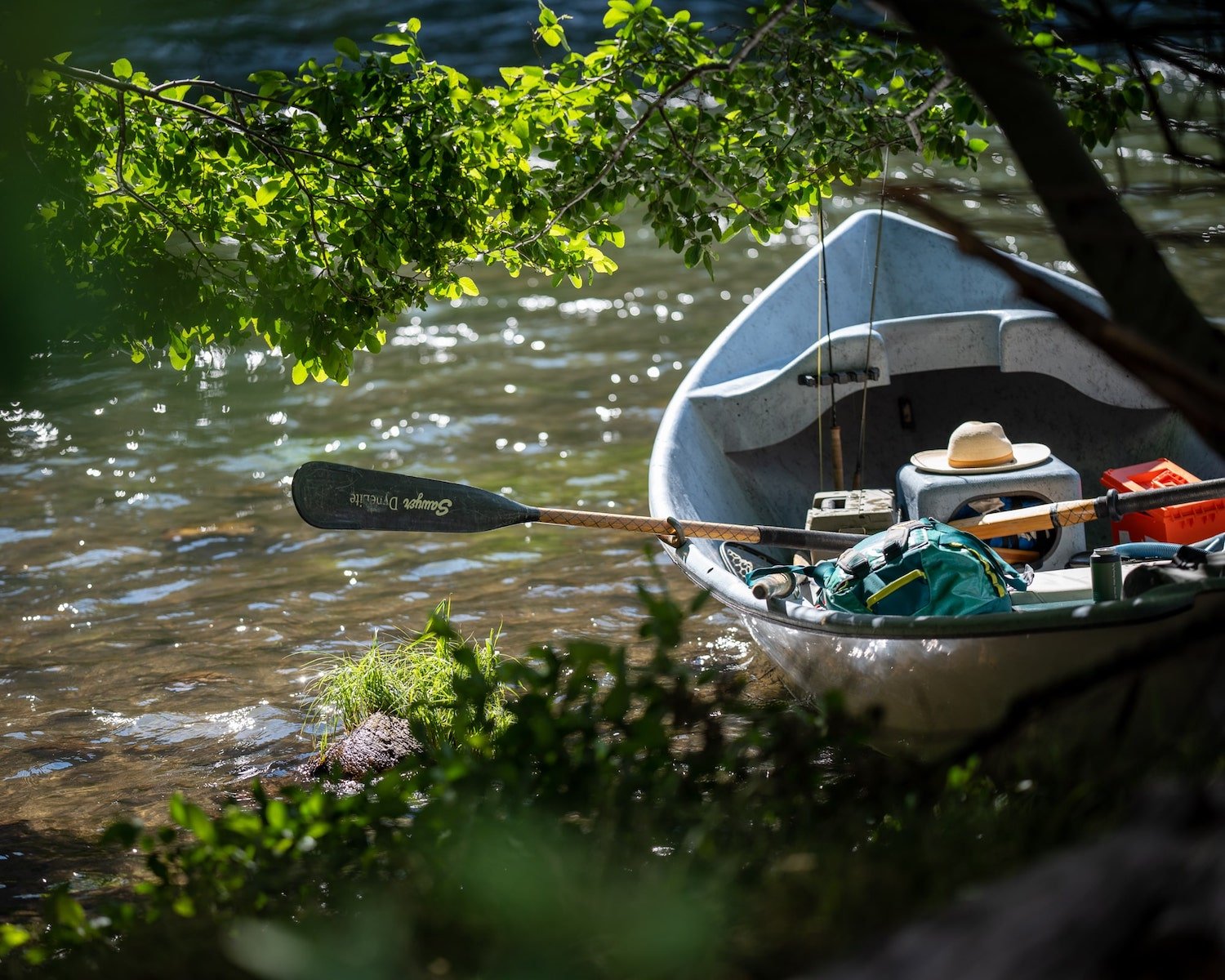
Fish of the Month: Fall Chinook
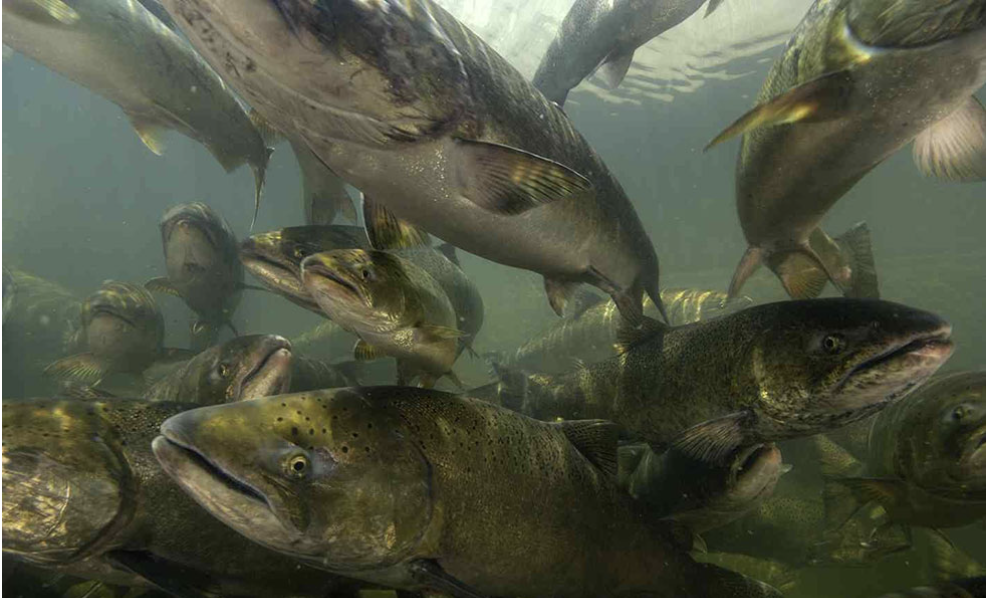
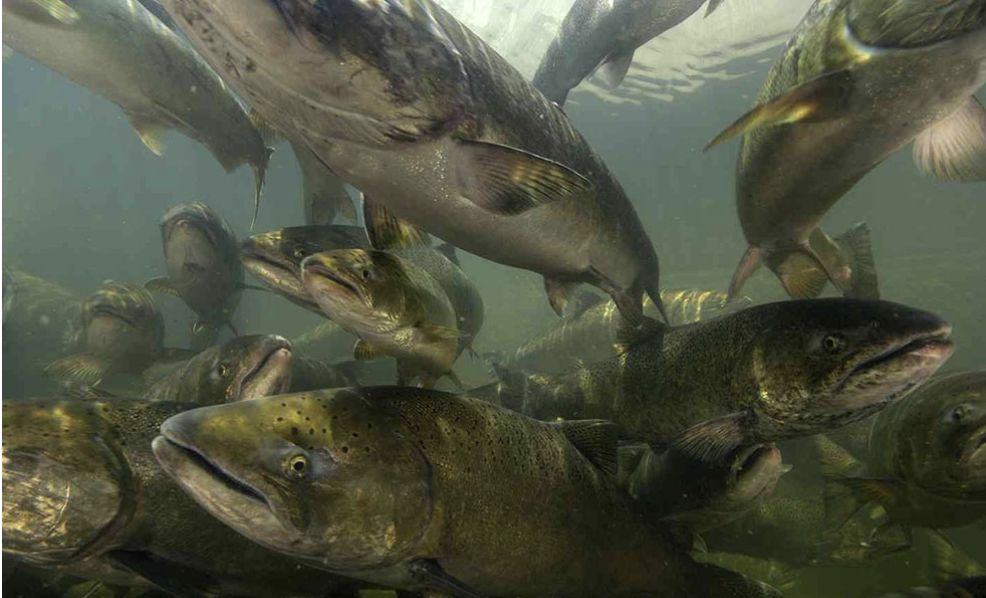
Fall Chinook, seemingly mugging for the camera. Photo courtesy of ODFW.
In Most Years, the Most Abundant Deschutes Salmonid
Fall Chinook salmon (Oncorhynchus tshawytscha)
Salmonid type – Salmonidae
Native species
Federal Endangered Species Act – not listed
State Sensitive Species List – Sensitive Species
By Steve Pribyl, ODFW fisheries biologist (retired)
Fall Chinook salmon are native to the Deschutes River and all are wild except for some hatchery strays. While they share many visual characteristics with the spring-run Chinook in the Deschutes (13 or more individual fin rays in the anal fin, large tri-lobed black spots against a light background, somewhat sickle-shaped tail, spots generally in the upper and lower lobes of the tail and a black gum line where the teeth emerge) they exhibit a different life history pattern, time of adult return and spawning behavior.
Typical of fall Chinook in the Columbia River basin, Deschutes fall Chinook show a specific set of life history characteristics. Adults typically enter the lower Deschutes in late summer to fall (more on this below) in a generally advanced stage of sexual maturity and do not spend long periods of freshwater holding time prior to spawning. Adult males take on a striking set of secondary sexual characteristics, including extensive red coloration, a somewhat exaggerated body shape including a bit of a forward hump and a well-developed kype or hooked upper jaw with prominent teeth. Spawning females display more muted secondary sexual characteristic but do develop some reddish coloration, a bit of a kype and more prominent teeth as well as a very round body shape in recognition of the large egg mass within.
A Unique Life History
Deschutes fall Chinook return from their ocean residency after one to five years. The smaller, younger individuals, nearly all males, are called jacks while the majority of a brood year return as either three- or four-year-adults after ocean residency. Fall Chinook adults in the lower Deschutes can be large– individuals exceeding 40 pounds have been captured— although the average adult is probably in the mid-teens.
Returning adult fall Chinook in the lower Deschutes have a protracted time of entry into the river. More than 40 years of migration data collected at the Oregon Department of Fish and Wildlife (ODFW) trap facility at Sherars Falls documents Chinook capture at that location as early as July and extending to early November. There has been speculation that the earliest of these returning fish may be the remnants of a summer Chinook population that spawned upstream of the Pelton Round Butte hydroelectric complex prior to its construction. Separation in either spawning time or place of this early- returning component from the later returning group was never documented, however, violating one of the biological necessities required to maintain group differences through time. It is now accepted among workers in the subbasin that there is only a fall Chinook population with a long period of adult return.
Fall Chinook are mainstem spawners that utilize larger gravel than other species, and spawn only in the main river. Spawning takes place throughout the lower 100 miles of the lower Deschutes. Eggs deposited in the gravel hatch and emerge after several months of incubation.
Spawning location is not evenly distributed, however, with a larger percentage of spawning upstream or downstream from Sherars Falls depending on the year. Spawning is largely complete by late January, although there are suggestions that water temperature changes from operation of the Selective Water Withdrawal tower (SWW) operation may have changed spawn timing either through colder fall temperatures or warmer winter temperatures.
The vast majority of lower Deschutes fall Chinook juveniles migrate to the ocean during the early summer several months after hatching in what is called a zero-age migration. Typical of other fall Chinook, Deschutes fall Chinook juveniles move slower down the Columbia and do feed during their downstream journey which is not characteristic of either spring Chinook or summer steelhead juvenile migrants. Operators of the Columbia River Federal Power System now spill water over Columbia River mainstem dams until September to aid downstream fall Chinook in recognition of this protracted seaward migration.
Unknown: Effect of PGE’s Flow Regime on Fall Chinook
As important as fall Chinook are to sport anglers, they are very important to members of the Confederated Tribes of the Warm Springs. Harvested at the Sherars Falls area for millennia by Warm Springs fishers, fall Chinook are important for ceremonial and subsistence purposes, and are the preferred salmon species for the traditional preservation method of drying. Tribal fishers can be seen to this day harvesting fall Chinook from platforms or scaffolds by traditional dipnet fishing.
The impact to fall Chinook from SWW operations on fall Chinook is uncertain. Portland General Electric (PGE) claims without proof that their present management of downstream temperature – principally colder river temperatures in the fall, made possible by releases through the SWW, benefit fall chinook. The DRA has been unable to substantiate these claims, and while fall Chinook adult returns to the river have been good in recent years, any relationship between temperature management by the SWW and adult returns is not apparent.
PGE also claims another benefit to fall Chinook is from the warmer water that the SWW puts in the river through the winter and spring, increasing juvenile fall Chinook growth rates. While this might be relevant to a point, there is also science that suggests that these faster juvenile growth rates may not be beneficial. One thing that is certain is that fall Chinook numbers in the lower Deschutes have gone up and down through the period of record according to a suite of environmental variables, but that temperature management of the lower river through SWW operations has not increased fall Chinook returns enough - if at all - to offset the other ecological harm to the lower Deschutes River that both DRA and PGE’s own studies have reported.
More From The Blog
Subscribe the the DRA Newsletter
The Deschutes River Alliance is your focused voice to protect the lower Deschutes River, its cold water flows and the fish and wildlife that are sustained by them. We send regular emails with important data and news about the lower Deschutes River. We will not sell your contact information to others.
How to Support the DRA
Everyone wants clean, healthy water in the Deschutes River. Oregonians cherish our clean and healthy waterways to provide drinking water, wildlife habitat and recreational activities. The lower Deschutes River is a federally designated Wild & Scenic River, and a national treasure. It must be protected for the environmental and economic health of Central Oregon. By working together we can return the lower Deschutes River to full health.