Clean Water Act Attack: Help Defend the CWA
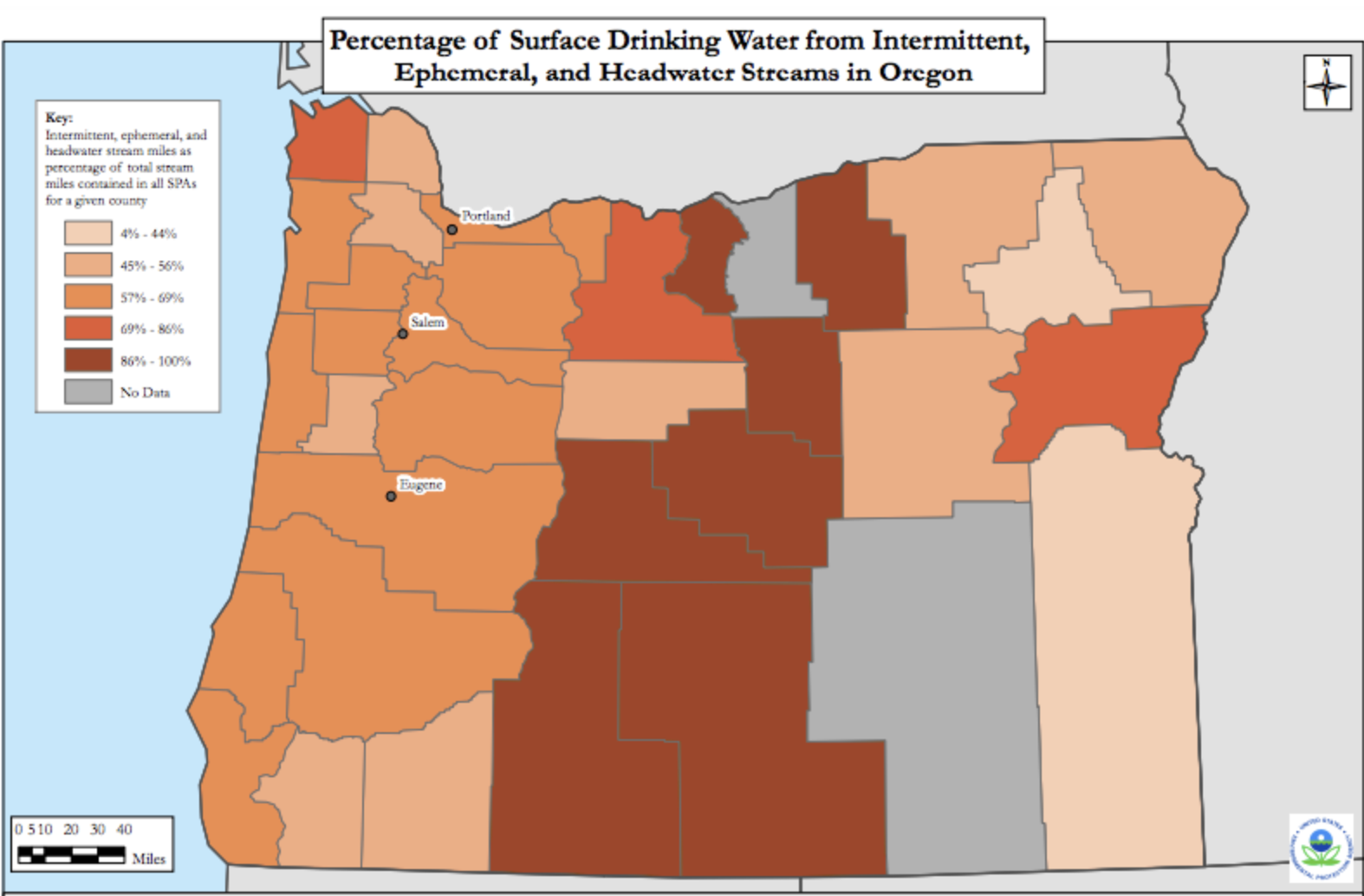
Most of the Deschutes Basin relies on water that won’t be protected under the Clean Water Act if proposed changes become reality.
Freshwater Habitat, Supply at Risk
The mission of the Deschutes River Alliance is to return colder, cleaner water to the lower Deschutes River. The water quality standards we persistently have asked the Oregon Department of Environmental Quality to uphold, and which unfortunately continue to be violated, owe their legal legitimacy to the federal Clean Water Act (CWA).
The CWA provides the legal framework for states to protect their waters, and includes provisions for the Environmental Protection Agency (EPA) to step in when states don’t meet clean water standards. The CWA spells out the standards by which water in the United States should be “fishable, swimmable, and drinkable.”
Passed in 1972 under the Nixon Administration, attempts to weaken the law by some pro-development and resource extraction interests have been in play since the law’s inception, but have never gained more traction than in the last couple years. A weakened CWA especially affects arid western states, including two-thirds of Oregon and the Deschutes basin.
In 2023, the U.S. Supreme Court weakened the CWA in its 5-4 decision in Sackett v. EPA. Contrary to any modern understanding of hydrological science, which demonstrates that wetlands, ephemeral streams and groundwater sources are intricately connected, the court limited the definition of “waters of the United States,” a key phrase in the CWA’s text, to perennial streams, lakes, rivers and oceans. The definition of “perennial” was taken up in subsequent bills and proposed federal administrative rule changes.
The PERMIT Act passed the U.S. House of Representatives in December of 2025. (The House-passed version has stalled in the Senate.) It affirms, then takes further the majority Supreme Court's narrower definition of “waters of the U.S.” It also targets section 401 of the law, which grants states and tribes the authority to review infrastructure projects affecting water quality. This could mean that even when states like Oregon intervene to uphold water quality protections, the PERMIT Act could effectively render enforcement impossible.
The Trump Administration in November of 2025, and again at the beginning of September in 2026, proposed supplemental rule changes to the CWA. The proposed rule change even further narrows the scope and definition of “waters of the U.S.,” stipulating that a wetland must have a permanent surface connection to a CWA-protected body of water to be worthy of consideration for protection. A GIS analysis performed by the Natural Resources Defense Council estimates that 94% of wetlands in the U.S. would be open to pollution or destruction, alongside 79% of stream miles.
Like the PERMIT Act, the proposed rule change would significantly weaken the 401 section of the law. (More on that below.)
Undoubtedly, these changes to the CWA have the potential to affect the Deschutes. Much of the basin relies for its drinking water on sources that would no longer be protected. Several tributaries in the lower Deschutes would likely not fit the new definition of “perennial.” Under the latest proposed rule-change definition from the EPA, a perennial stream would have to have water flowing throughout its length every day of the year. If the stream is dry for 30 consecutive days, it would not be protected by CWA provision.
The DRA, alongside many other organizations in the state, rely on the 401 section of the law in their work to maintain and improve water quality. Section 401 Water Quality Certification is a state or tribal approval required under the CWA for any project that needs a federal permit and could discharge pollutants into local waters. This section of the law balances authority between federal agencies, states, tribes and their citizens to uphold water quality standards. Projects affecting water quality are required to adhere to standards spelled out in a 401 certification that is a key part of its license to operate. Portland General Electric, for example, must maintain water quality standards spelled out in its Pelton Round Butte Project 401 certification.
Though DEQ and the last two governors have criticized the weakening of the CWA, and vowed to uphold current water quality standards even with federal rollbacks in place, shifting the sole burden of review and enforcement to states costs resources–staff time and money–in an era when DEQ’s budget has already been slashed. In a time of rapid development of infrastructure, particularly the proliferation of water and power-guzzling data centers, gutting legal avenues to protect water looks reckless.
Submit Your Comments on Clean Water Act Rule Changes
The proposed rule change from the EPA will make the work of protecting and restoring the lower Deschutes River all the more difficult. The DRA has submitted comments outlining our concerns at: https://www.regulations.gov/ and encourages our supporters to submit their own before the October 9th deadline. In the subject line on the email, include Docket ID No. EPA-HQ-OW-2025-0322.
More From The Blog

Subscribe the the DRA Newsletter
The Deschutes River Alliance is your focused voice to protect the lower Deschutes River, its cold water flows and the fish and wildlife that are sustained by them. We send regular emails with important data and news about the lower Deschutes River. We will not sell your contact information to others.
How to Support the DRA
Everyone wants clean, healthy water in the Deschutes River. Oregonians cherish our clean and healthy waterways to provide drinking water, wildlife habitat and recreational activities. The lower Deschutes River is a federally designated Wild & Scenic River, and a national treasure. It must be protected for the environmental and economic health of Central Oregon. By working together we can return the lower Deschutes River to full health.