Bug of the Month: Net-Spinning Caddis
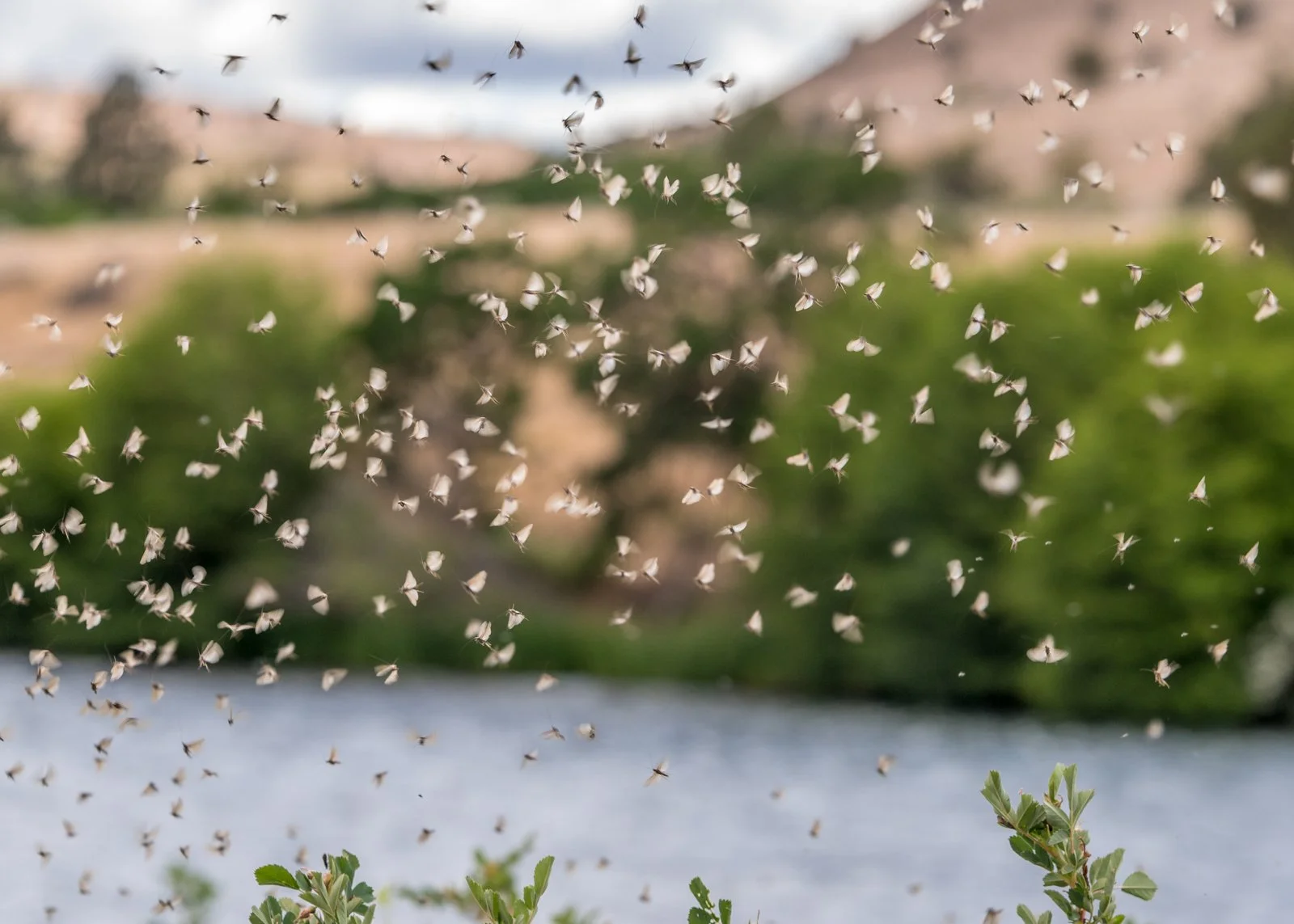
A swarm of net-spinning caddis, pleasing to both trout and trout anglers. Photo courtesy of Rick Hafele
Which Caddis Are We Talking About?
By Hannah Camel
We’re back with another installment of the Deschutes River Alliance’s Bug of the Month series! Throughout 2026, we’re shining a spotlight on the aquatic insects that help make the lower Deschutes River such a remarkable fishery. Each month, we dive into the life history, habitat, seasonal timing, and abundance of a different species, while incorporating insights from the DRA’s water quality and macroinvertebrate monitoring programs. And because knowing the bugs is only half the fun, we also include guide-approved fly patterns and practical tips to help you match the hatch on the water.
With summer in full swing, it’s time to turn our attention to one of the river’s most abundant and dependable insects: the Net-spinning Caddis. If you’ve spent an evening on the Deschutes in July or August, chances are you’ve already met them. Their prolific hatches can fill the air with fluttering adults, end up in your camp dinner, or swarm every lantern and headlamp along the riverbank. While they might be a minor nuisance around camp, they’re a major food source for trout, making them one of the most important, and often overlooked, insects anglers should have on their radar.
Life History
Before we dive in, there’s one small complication. When anglers talk about net-spinning caddis, they’re actually referring to several closely related groups of caddisflies. On the lower Deschutes, the two genera you will find are Hydropsyche and Cheumatopsyche. Both belong to the order Trichoptera and the family Hydropsychidae, or net-spinning caddisflies. Across North America, there are roughly 80 described species of Hydropsyche and more than 40 species of Cheumatopsyche.
Although these two genera look remarkably similar, there are a few important differences. Hydropsyche species are generally larger and more diverse throughout North America. They also tend to prefer cleaner, cooler, well-oxygenated streams. Cheumatopsyche, on the other hand, is more tolerant of warmer water, lower dissolved oxygen levels, and higher amounts of organic pollution, allowing it to thrive in conditions where other caddisflies may struggle. Despite these ecological differences, both genera occupy similar habitats in the lower Deschutes.
If you're wondering how to tell them apart, you're not alone. Net-spinning caddis are notoriously difficult to identify. Distinguishing one species from another usually requires examining tiny anatomical features under a microscope, making accurate identification nearly impossible with the naked eye. Fortunately for anglers, that's not a problem. Because Hydropsyche and Cheumatopsyche share nearly identical appearances, life histories, habitat preferences, and hatch timing, they're typically treated as a single group. They're also commonly known among anglers as the Spotted Sedge. So, to keep things simple, we'll refer to both groups collectively as net-spinning caddis throughout the rest of this blog.
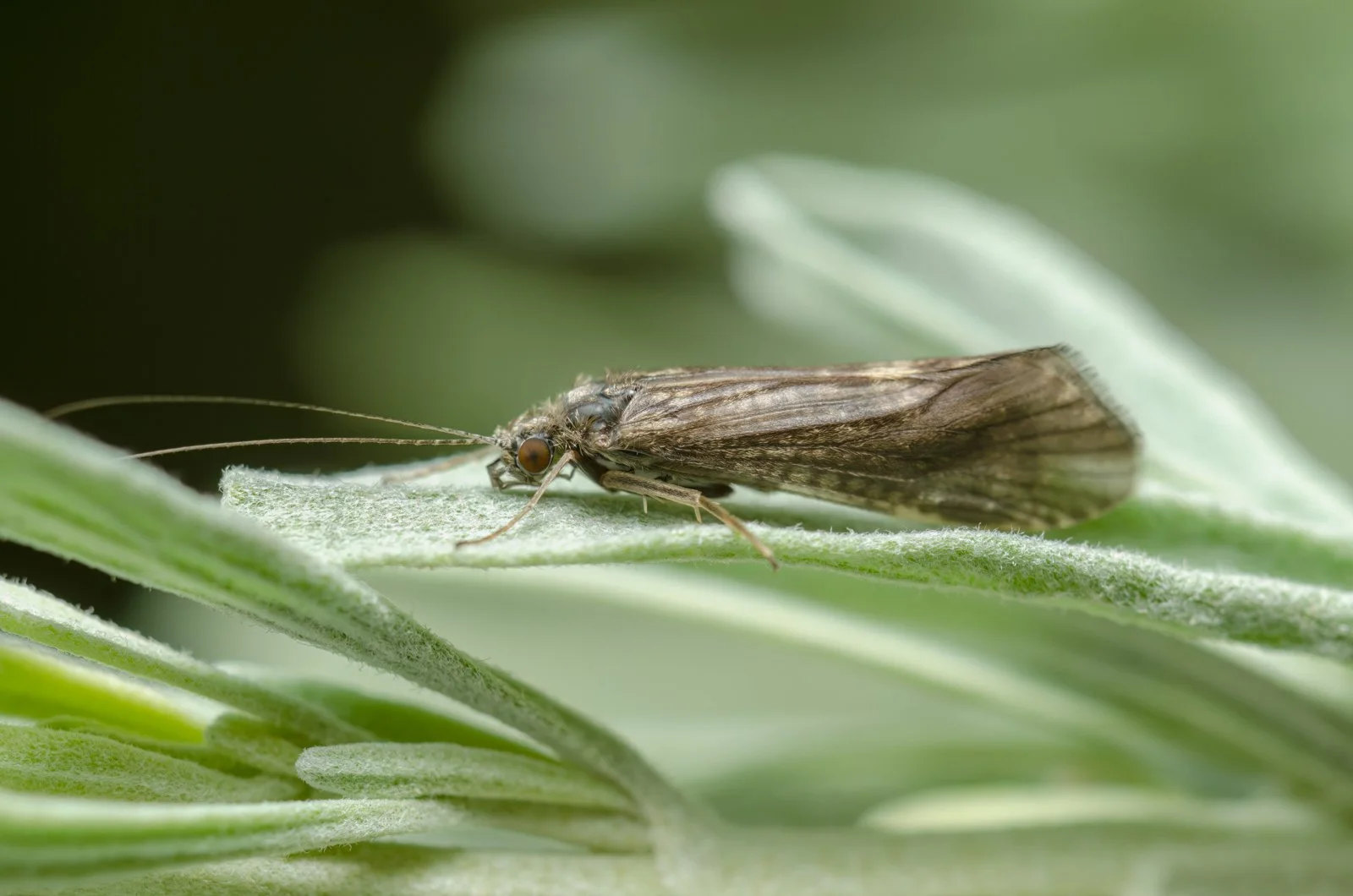
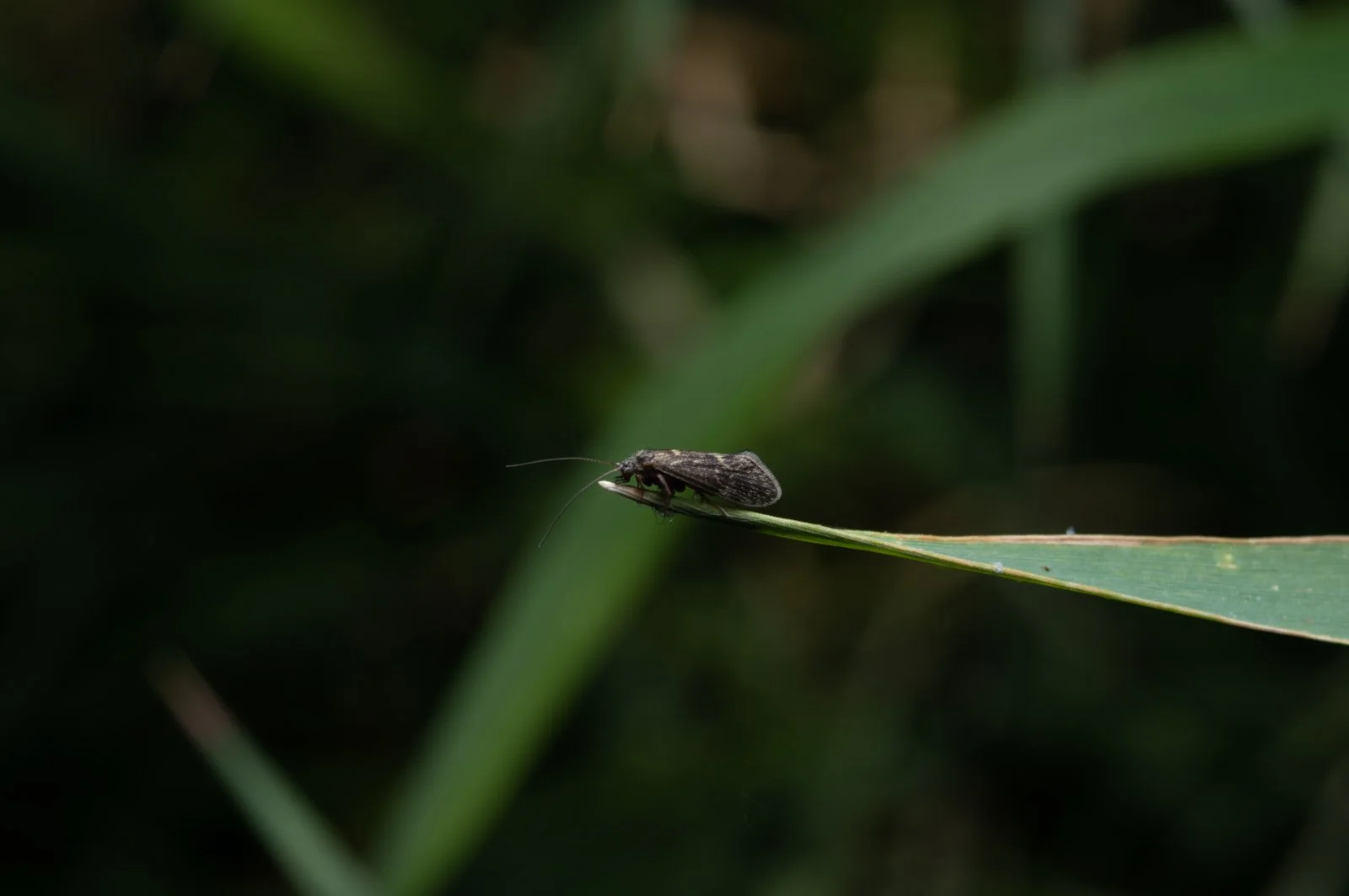
Up close: net-spinning Hydropsyche in repose. Photo Courtesy of Rick Hafele.
Underwater Songs: The Chirp Language of Net-Spinning Caddis
Emergence and Distribution
Net-spinning caddis are found throughout much of North America, wherever cool to moderately warm flowing rivers and streams provide the swift current they need to survive. On the lower Deschutes, they're one of the most abundant aquatic insects, with hatches occurring from late spring through early fall. While you may see a few adults on the wing as early as May or as late as September, the most prolific hatches, and the thick evening swarms that every Deschutes angler knows, typically occur from June through August.
Like many aquatic insects, net-spinning caddis time their daily emergence around favorable light conditions. Adults most commonly emerge during periods of low light, especially around dawn, dusk, or on overcast days. On warm summer evenings, it's not uncommon to see clouds of adults gathering over riffles before returning to the water to mate and lay eggs.
The timing of these hatches is closely tied to water temperature. Because caddisflies are cold-blooded, their development depends on the amount of heat they accumulate throughout the year. Entomologists measure this using degree-days, a running total of thermal energy absorbed over time. Once the larvae have accumulated enough degree-days, they're ready to emerge as adults.
This is why hatch timing can vary from year to year. Warm springs allow larvae to reach their developmental threshold sooner, producing earlier hatches, while cool springs slow development and delay emergence. Unlike some of the mayflies we've featured in previous Bug of the Month articles, net-spinning caddis don't appear to rely on a single "magic" water temperature to trigger emergence. Instead, their hatch timing is driven more by accumulated warmth over the season than by reaching one specific temperature, which helps explain why they can emerge consistently over several months.
Habitat and Behavior
Like butterflies, net-spinning caddisflies undergo complete metamorphosis, passing through four distinct life stages: egg, larva, pupa, and adult. Every caddisfly starts life as an egg. After mating, females return to the river and dive beneath the surface, swimming all the way to the bottom to attach strings of eggs to submerged rocks and other hard surfaces. After a few weeks of incubation, the eggs hatch into tiny larvae, beginning the longest stage of their lives. On the lower Deschutes, the larval stage typically lasts close to a year.
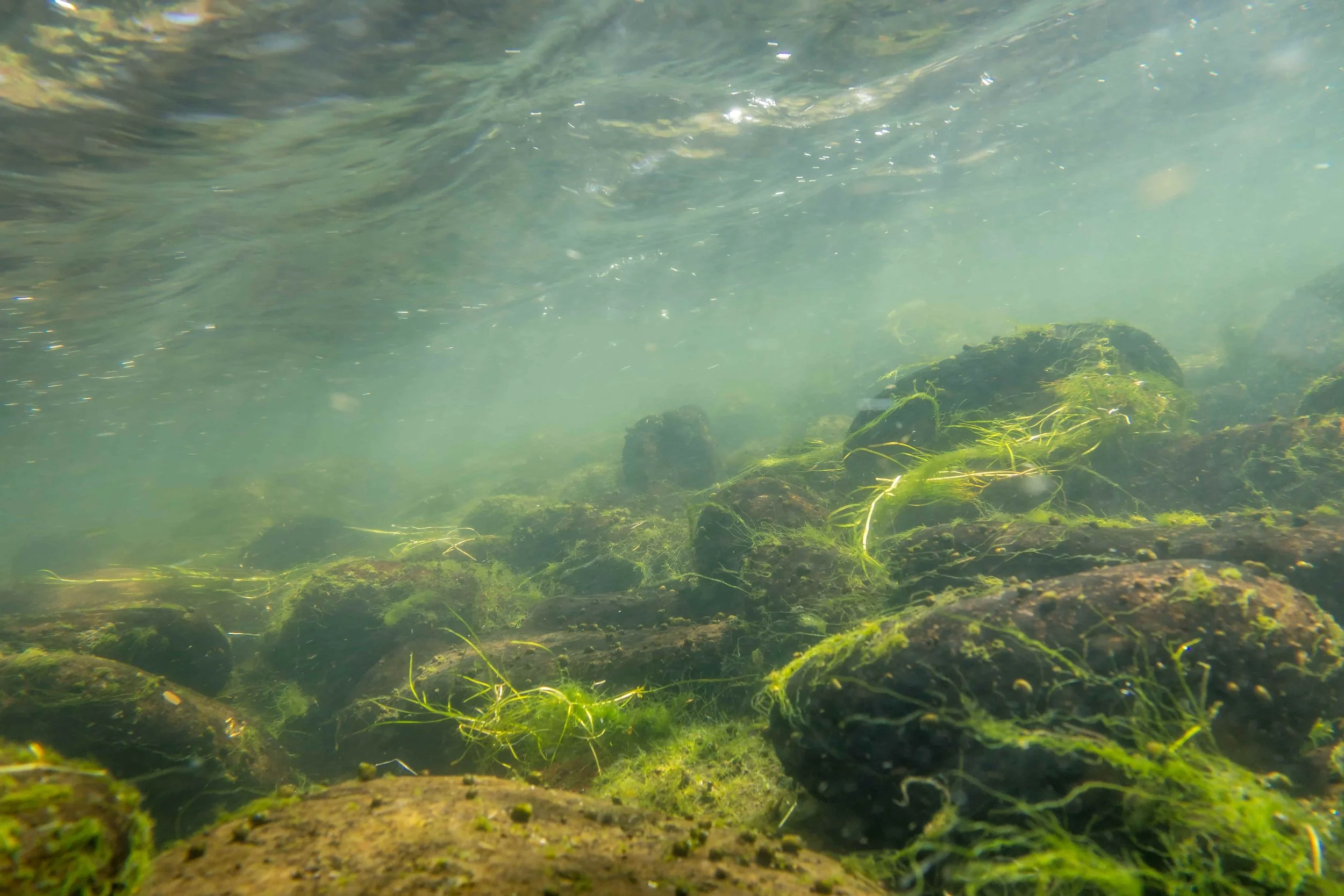
When most people think of a caddisfly larva, they picture those little pebble-covered "cases" stuck to the rocks. Hidden inside those portable homes are case-building caddisflies. But members of the net-spinning caddis family do things a little differently. As their name suggests, Hydropsyche and Cheumatopsyche never build protective cases. Instead, they construct a small silken retreat beneath rocks in riffles and runs. Extending from the entrance of this retreat is a finely woven silk net that functions like an underwater fishing net.
As water flows through the net, it captures drifting algae, diatoms, fine organic matter, and even tiny aquatic insects. The larva periodically crawls out to harvest its catch before repairing or rebuilding the net. Because they rely on flowing water to deliver food, net-spinning caddis are almost always found clinging to rocks in moderate- to fast-flowing currents.
Living in prime real estate comes with one drawback—crowding. In productive riffles, larvae can become so abundant that neighboring nets begin interfering with one another, reducing each larva's ability to capture food. To make matters worse, these little opportunists aren't above raiding a neighbor's net for an easy meal. Fortunately, they've evolved an ingenious solution: they chirp.
That's right, net-spinning caddis larvae actually produce sounds underwater. They create these chirps by rubbing part of their front legs against a series of tiny ridges on the underside of their head, a process known as stridulation. The sounds are loud enough to be detected by underwater microphones and are thought to help establish territories, discouraging nearby larvae from encroaching on an occupied feeding site. Different species produce slightly different chirps because the shape and spacing of their ridges vary, almost like each species has its own unique underwater language.
Most net-spinning caddis larvae are shades of brown or dark olive, although some species can be surprisingly bright green. As they grow, they molt through five developmental stages, known as instars, before reaching maturity.
When fully grown, the larva seals itself inside its silken retreat and transforms into a pupa. Over the next four to five weeks, one of nature's greatest transformations takes place as the larva develops into a winged adult.
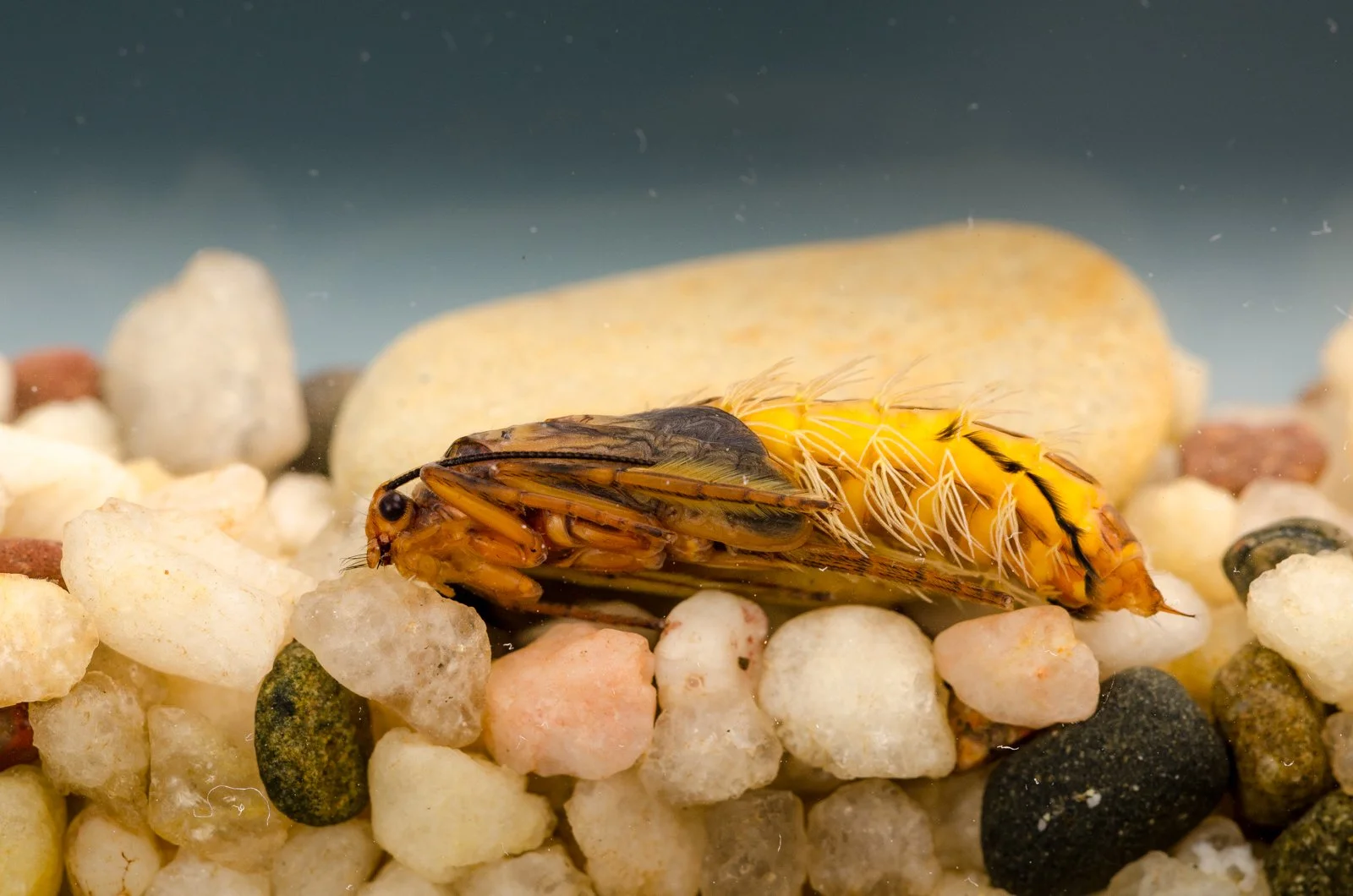
Unlike mayfly nymphs, caddisfly pupae are surprisingly active. Once development is complete, the pupa uses specialized mandibles to cut its way out of the silk retreat before swimming rapidly toward the surface. Dense hairs on its legs act like tiny paddles, helping propel it upward with a quick, darting motion that trout have learned to recognize, and eagerly intercept.
Upon reaching the surface, the adult caddis quickly sheds its pupal skin and takes flight. Adults are relatively small, measuring about 6–12 mm long, with mottled tan, olive, gray, or brown wings that are held tent-like over the body when at rest.
Adult net-spinning caddis typically live for only one to three weeks, spending most of that time finding a mate and reproducing. On warm summer evenings, large mating swarms often gather above riffles and along streamside vegetation. After mating, females return to the river, dive beneath the surface once again to lay their eggs, then slowly swim back toward the surface to complete the cycle.
On the lower Deschutes, these evening flights can become so dense that they blanket the river, cover camp lights, and provide trout with an almost endless supply of food.
Digging into the Data: DRA Macroinvertebrate Monitoring
Now that we've covered the basics of net-spinning caddis, let's see what the Deschutes River Alliance's macroinvertebrate monitoring tells us about their abundance on the lower Deschutes River.
Our lab identifies net-spinning caddis to the genus level, allowing us to distinguish between Hydropsyche and Cheumatopsyche, but not individual species.
At the upstream Warm Springs monitoring site, DRA spring samples averaged 187 Hydropsyche/m² and 31 Cheumatopsyche/m². By fall, those numbers increased dramatically to an average of 1,605 Hydropsyche/m² and 967 Cheumatopsyche/m², reflecting the seasonal buildup of larval populations before emergence.
Comparing these results to macroinvertebrate data collected before the Selective Water Withdrawal Tower was installed reveals an interesting pattern. At comparable upstream sites, pre-tower samples averaged 376 Hydropsyche/m² and 35 Cheumatopsyche/m² in the spring, while fall samples averaged just 176 Hydropsyche/m² and 10 Cheumatopsyche/m².
Overall, post-tower monitoring shows relatively similar spring abundances between the two periods, but substantially greater fall abundances, particularly for Cheumatopsyche. Cheumatopsyche increased from fewer than 10 individuals/m² before tower operations to nearly 1,000 individuals/m² in DRA's fall monitoring. Hydropsyche also shows a notable increase in fall abundance, although the change is less dramatic than that observed for Cheumatopsyche.
What might explain these changes? One possibility is the influence of the SWW Tower on food availability. Rivers immediately downstream of reservoirs often support exceptionally dense populations of net-spinning caddis because plankton and zooplankton produced in the reservoir are transported downstream, providing an abundant food source for these filter-feeding larvae. Since the SWW Tower has increased surface-water releases from Lake Billy Chinook during much of the year, it may also be increasing the downstream transport of plankton, creating more favorable feeding conditions for both genera.
The differences between the two genera may also provide some clues. As discussed earlier, Hydropsyche generally prefers cooler, well-oxygenated water, while Cheumatopsyche is more tolerant of warmer temperatures, lower dissolved oxygen, and higher organic enrichment. The much larger increase in Cheumatopsyche, particularly in the fall, may therefore reflect a combination of increased food availability in the form of warmer, nutrient-rich water that favor this more tolerant genus.
While these patterns are compelling, they should be viewed as hypotheses rather than definitive conclusions. Net-spinning caddis populations are influenced by many interacting factors, including; streamflow, water temperature, food availability, and habitat quality. Additional long-term monitoring will help determine what is driving these changes.
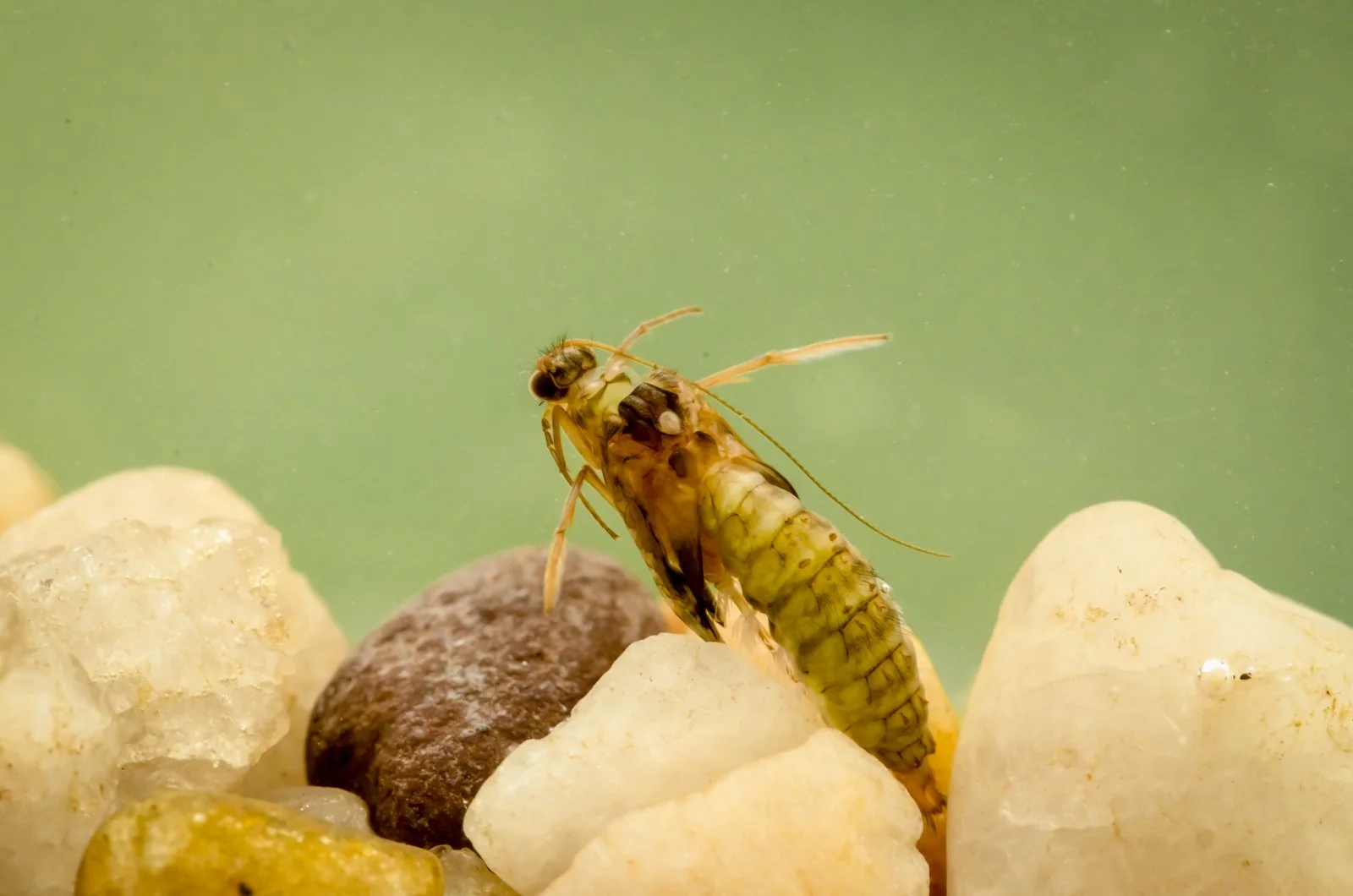
Net-spinning caddis pupa. Photo courtesy of Rick Hafele.
Fly Patterns and Fishing Tips
Understanding the life cycle and behavior of net-spinning caddis is the first step to fishing them successfully. The second is knowing which life stage the trout are feeding on. Fortunately for anglers, net-spinning caddis can be imitated effectively as larvae, pupae, and adults, with each stage shining under different conditions.
Larval Imitations
Unlike most caddisflies, net-spinning caddis don't have the luxury of carrying around a protective stone case. Instead, they cling directly to rocks in fast water, making them much more vulnerable to being knocked loose by strong currents or drifting debris. They also intentionally enter the drift from time to time, a behavior known as behavioral drift, allowing them to disperse downstream and colonize new habitat. During this journey, they're an easy meal for waiting trout. Because of this, larval patterns can produce fish throughout the season.
Fortunately, trout aren't overly picky when it comes to caddis larvae. Almost any caddis larva pattern will get the job done, even a simple Green Rock Worm, as long as you match the size and general color. Look for heavily weighted patterns in olive, green, tan, or brown in sizes 10–16. If the DRA's macroinvertebrate sampling has taught us anything, it's that you can never go wrong carrying a few extra olive and green patterns.
Fish larval imitations beneath a strike indicator through deep riffles, runs, and pocket water. Add enough weight to keep the fly ticking the rocks every few feet. Since natural larvae spend nearly their entire lives clinging to the streambed, the closer your fly stays to the bottom, the more convincing it will be.
Pupa Imitations
As hatch time approaches, pupa patterns become highly effective. After weeks hidden beneath the rocks, the mature pupa cuts free from its silken retreat and swims quickly toward the surface. This rapid ascent is full of movement, making it easy for trout to spot and intercept.
Pupa patterns can be fished in several ways. A dead drift beneath an indicator works well before fish begin actively feeding near the surface. As the hatch intensifies, try allowing the fly to swing and rise at the end of each drift. That rising motion closely imitates the natural pupa on its way to the surface and often triggers aggressive strikes.
When it comes to fly patterns, few have stood the test of time like Gary LaFontaine's Sparkle Pupa. Often considered the gold standard of caddis pupa imitations, its Antron body traps tiny air bubbles that perfectly mimic the shimmering appearance of a natural pupa ascending toward the surface. Carry the pattern in tan, olive, and brown in sizes 12–16, and you'll be prepared for nearly any net-spinning caddis hatch on the Deschutes.
Adult Imitations
When the adults begin emerging, or later return to the water to lay eggs, the action can be spectacular. Summer evenings on the lower Deschutes often bring clouds of fluttering caddis over the riffles, and trout quickly take notice. During heavy hatches, it's not uncommon to look across a back eddy and see hundreds of adults skating, struggling, and drifting in the surface film. There have been evenings when I've had a hard time picking out my own fly among the countless naturals floating by. It's one of those good problems every dry-fly angler hopes to have.
One of my favorite patterns for these situations is the X-Caddis, developed by Craig Matthews of West Yellowstone. At first glance, it resembles the classic Elk Hair Caddis, but instead of hackle it uses a trailing shuck of Zelon or Antron that hangs in the surface film, perfectly imitating a freshly emerged or struggling adult. Because it rides low in the water, trout often find it more convincing than higher-floating patterns.
Fish the X-Caddis in sizes 12–18, matching the natural color of the hatch—typically tan, olive, or dark brown. Present it with a drag-free drift, using a little slack in your cast whenever possible. Since the fly sits low in the surface film, even slight drag can make it look unnatural. If fish begin aggressively chasing egg-laying adults skating across the surface, don't be afraid to add a subtle twitch or gentle skate at the end of your drift. Sometimes that little bit of movement is all it takes to draw an explosive rise.
That wraps up this month's Bug of the Month! Thanks for reading, we hope you not only learned a little more about the fascinating net-spinning caddis, but also gained a new appreciation for one of the lower Deschutes' most abundant and dependable trout foods. While these insects don't always get the same attention as salmonflies or mayflies, their sheer numbers make them an essential part of the river's ecosystem and one of the most reliable hatches of the summer.
With long days and warm evenings upon us, now is the perfect time to experience one of the Deschutes' legendary caddis hatches. Sleep in, wait for the evening hatch, and enjoy some of the most exciting dry-fly fishing of the year. As always, with summer water temperatures on the rise, please fish responsibly by targeting the cooler parts of the day, handling fish as little as possible, and releasing them quickly to help reduce stress.
Stay tuned for next month's featured bug, and until then, keep 'em wet and enjoy the rest of your summer on the lower Deschutes!
More From The Blog

Subscribe the the DRA Newsletter
The Deschutes River Alliance is your focused voice to protect the lower Deschutes River, its cold water flows and the fish and wildlife that are sustained by them. We send regular emails with important data and news about the lower Deschutes River. We will not sell your contact information to others.
How to Support the DRA
Everyone wants clean, healthy water in the Deschutes River. Oregonians cherish our clean and healthy waterways to provide drinking water, wildlife habitat and recreational activities. The lower Deschutes River is a federally designated Wild & Scenic River, and a national treasure. It must be protected for the environmental and economic health of Central Oregon. By working together we can return the lower Deschutes River to full health.