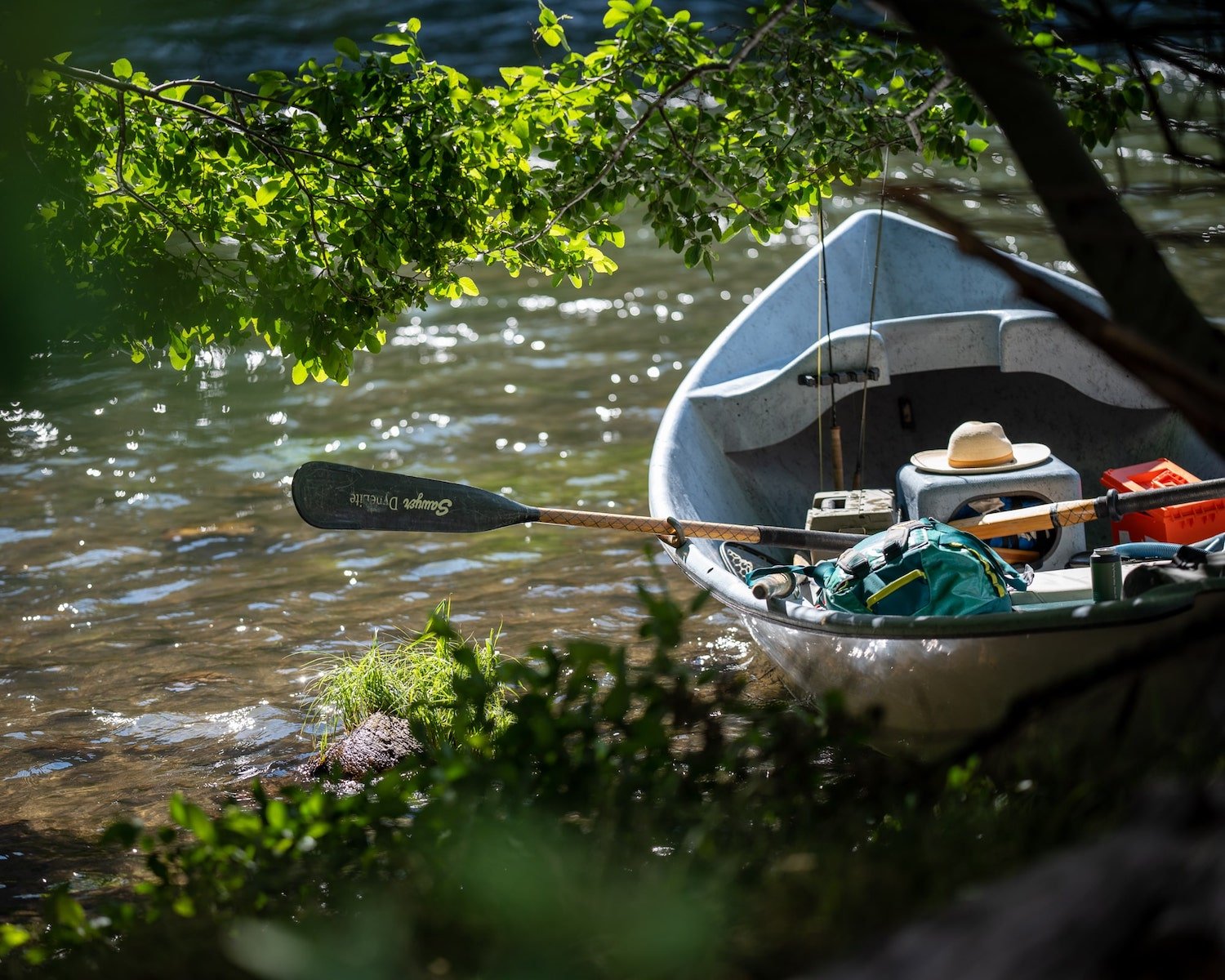
Steelhead Masters: The Early Days
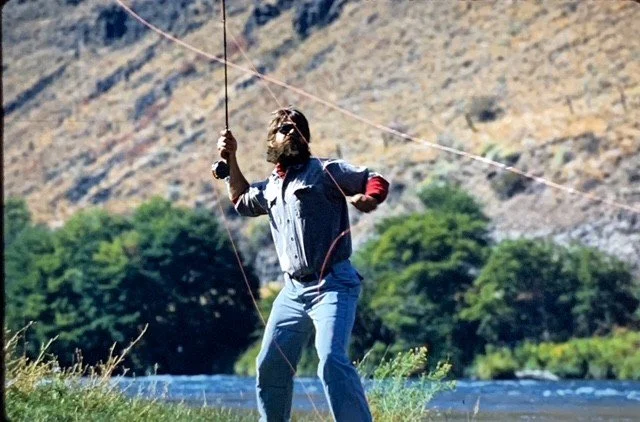
John Hazel hucking a lot of line—with a lot of beard and blue jeans—at one of his casting lesson sessions just a few years back.
Reeling in the Years
Editor’s Note: The DRA is proud to sponsor Steelhead Masters, June 9th at the Mission Theater, 1624 NW Glisan Street. Doors open at 6 p.m. Bill Bakke, John Hazel, Steve Pettit, and Randle Stetzer, with more than two centuries of steelhead experiences between them, will tell stories, share photos, and offer insight from their lives spent in pursuit of chrome. Find out more and purchase your tickets here.
What follows is an interview with John Hazel and Randle Stetzer, offered as a preview of the June 9th event.
You Can Catch Steelhead on a Floating Line?
DRA: What was it like to pick up a fly rod in the mid-1970s and cast for steelhead around the rivers of the Pacific Northwest? How did you figure out you could catch steelhead on a floating line?
Randle Stetzer (RS): I remember it well, actually. For me, I had always heard steelhead you had to catch with a sink tip. And then I ran into this guy on the Washougal River; not knowing who he was, and he was obviously fly-fishing, and I asked him, I said, “how do you catch these fish?” And he says, “well, the first thing you need to do is get rid of that sink tip and get a floating line.” And it happened to be Bill McMillan, actually. And so I went out and bought myself a double taper 8. Floating line and that's all I fished from that point for a while.
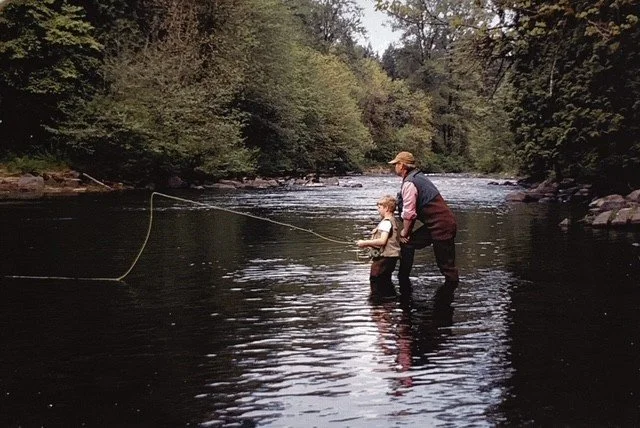
Randle Stetzer and his son, skating flies for steelhead on the Washougal River.
John Hazel (JH): You know, the Grease Line Fly Shoppe opened up in either late ‘76 or early ‘77, and they had already advertised in Salmon Trout Steelheader magazine for months and months and months that this fly shop was coming to town. And they were specializing in steelhead. And a guy by the name of Bill McMillan and Mark Noble were the operators, and Bill had lots of articles published in Salmon Trout Steelheader by then. And it was quite a famous name already. So I just drove by the location for months and months and months and months, waiting for it to open up and it hadn't opened, it hadn't opened, it hadn't opened, and one day it was open. And I walked in there. And then, I think it was Bill [McMillan] who I first saw working there.
He was explaining to me how you can catch steelhead on a floating line year-round. And I'm going, okay, just give me more, you know, give me more. And that's what I did for the next three years. So he got me started correctly, but didn't give me all the information. That was the thing about Bill, he would give you snippets. And you would learn on your own. He probably wanted it to be that way, knowing Bill a little bit. The Greased Line printed a catalog at the time, and Bill wrote the catalog and put in lots of cool information in that catalog about flies and lines and rods and reels, and a little bit about technique. And you just read it over and interpreted it as many ways as you could to get more information out of it, and off you went, right?
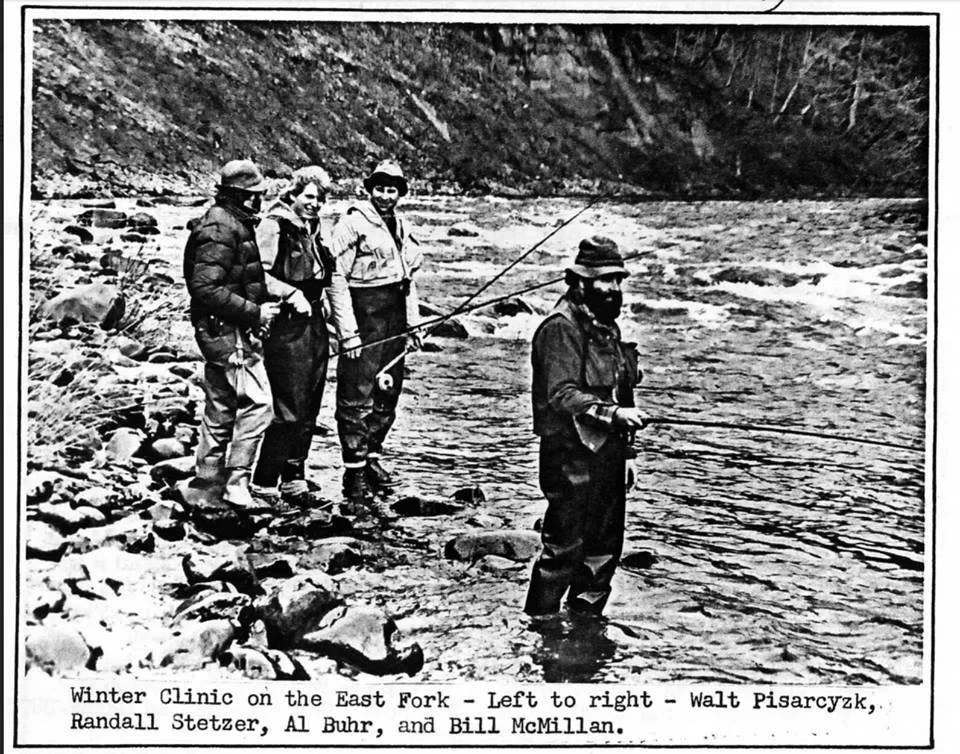
Bill McMillan is credited with convincing many anglers to ditch the sink tip.
RS: I got a little side note here, that's [The Greased Line Fly Shoppe] where John and I first met each other. I think I was behind the counter covering for those guys one afternoon. And John comes walking in. It's not the John we know today, because he was clean-shaven and working for the Thunderbird Red Lion Hotel chain at the time. And we decided to go do something. I was gonna do a spawning survey on Panther Creek on the Wind River. And that was our first trip together.
JH: Was that our very first trip?
RS: That was our very first trip together. John shows up with a brand new pair of Seal Dries, a new pair of waders. And I said, you might not want to wear those because we gotta bushwhack. He says, no, it'll be fine. You didn't get probably what, 30 yards away from the truck?
JH: They exploded. Oh, God, it was funny.
DRA: The related question here is what was the gear like? Talk about the rods, the reels, the lines. Who was tying the flies?
RS: The first rod I bought was an 8.5 foot for an 8 weight. Fenwick fiberglass. And then getting hooked up in the Greased Line Fly Shoppe, all the rods that they had at the time were J.K. Fisher fiberglass rods, soon I had a 9-foot 7 weight, 9.5 for an 8 weight, 9 and-a-half for a 9. I still have those rods actually. Still fish them once in a while. And then Hardy Reels, Hardy St. John's and St. George's were the real deal.
JH: And remember this, you could buy the rod two ways, yes, right? You could buy the rod premade. Yep. Or you could take home all the components and build it yourself. And that's what I ended up doing.
Around this time you guys were both starting to spend some considerable time on the lower Deschutes. What could you expect on a typical day of steelheading back then? How did the river look different?
JH: Well, I mean, hell, everything looked different, right? I got a lot of pictures of the Deschutes River where we're standing on the bank looking at our buddies swing the fly, right? I think that was back when we could sit up there and argue about who has to fish and who gets to watch. And you wanted to watch, to see those fish grab. I've got pictures, and the water is gin clear, and every rock on the bank is like bare bones rock. There's not a piece of algae in that river. I remember seeing Randy out there. I didn't know he was even on the river. And I'd see him. Yeah, he'd be doing a camp trip, but I'd be doing a guide trip in my old wood boat, right?
RS: I really didn't go over to the Deschutes much myself, but had a good friend, a mutual friend of John and I, Marty Sherman, who took me over there a couple times in the late 70s. That introduced the river to me and then I started working out there. And then that's when John and I would run into each other, working on the river.
JH: I didn't know he was out there. And it sounds like you didn't know I was out there until we kept running into each other at The Oasis. He'd be buying gas. Filling up his little red truck.
DRA: Who were the guides? Obviously, there must have been a few guys around before your time and who were those people?
JH: Lynn Sawyer was out there. Skip Zaffe. Mike McLucas. Doug Stewart. Homer Baker.
DRA: A lot of rivers where summer steelhead were the primary quarry have seen those runs severely reduced or extirpated. Can you recall one or two places where you used to hook steelhead where that is now much harder or impossible? And what happened to those runs?
RS: There's one run, John knows this run very well as well. We call it, used to call it, The Signal, and it was one of those runs where it wasn't a matter of if, it was a matter of how many. And it just isn't there anymore. It's just totally gone.
JH: The ‘96 flood changed it completely. Another great run that was very cool was lava ledges. That spot was a gift, and that's where you and I really discovered steelhead eating flies.
RS: Throughout my entire fishing career, I've kept a logbook and records of all the steelhead that I've caught and, and when I was guiding, the ones my clients caught, and there were years where when I was doing the lower river camp floats. My boat, which consisted of three anglers, basically, most of the time, we'd have between 35 and 40 takes from steelhead in a four-day window. And then just before I quit guiding, we were lucky to have 40 in a season.
JH: We kept a logbook, both of us, and I remember reading those pages. It would be the second week of August. I wrote, “oh, we only hooked four this morning and lost three more tonight. Soon the fish will come in. So it will get better.” Having six or eight hookups in the course of a day was just standard, not terrific.
DRA: How has the conservation ethic evolved?
RS: I used to preach when we were doing the [casting] schools and on our guide trips: “you're doing this, now you need to give back.” And it got to where, at first guys were really into that and did give back. But, as the crowd got younger and younger, it seems like there was less and less of that.
JH: When did we start the Native Fish Society? Early 90’s? (editor’s note: it was 1995.) It was Bill Bakke, and you and me, a few others; that was a small group of people. You know, I feel really proud of that because we built that organization up. We were the grassroots. When you're a grassroots organization, you got a lot of juice. You know, you think you're going to get some things done, right? Now we're all old. We've been fighting these wars for the better part of 50 years. We know that juice isn't what makes the world go around. It's politics, just a lot of crap gets in the way.
DRA: How do we move past the crap? There’s so much more information. Do you think people are paralyzed by how much is out there? Are we any better informed than in those early days?
RS: When I first really got to know Bakke and Pettit was during the [early 90’s] time of the Columbia River Fish Commission, where the governor appointed two people from each state, Oregon, Washington, Idaho, and Montana, to sit on this commission to oversee BPA [The Bonneville Power Administration] in the Columbia River. Pettit, Bakke and I were sitting at a table listening to this group and then getting ready to testify. The discussion was over king [Chinook] salmon. And the rep from Idaho, he interrupted everything right then and there and says, “okay, so you've told me when the kings arrive. When do the queens get here?” He was totally serious, and the room just went quiet.
DRA: So laugh a lot, I suppose is one answer.
JH: I bet [Steve] Pettit and [Bill] Bakke will have a lot to say about that last question [at the Steelhead Master’s event, June 9th.] Those two guys were our mentors, along with Bill McMillan. They’ve had a good long run.
RS: Even longer than us.
JH: Well, it’s time to celebrate both of them.
More From The Blog
Subscribe the the DRA Newsletter
The Deschutes River Alliance is your focused voice to protect the lower Deschutes River, its cold water flows and the fish and wildlife that are sustained by them. We send regular emails with important data and news about the lower Deschutes River. We will not sell your contact information to others.
How to Support the DRA
Everyone wants clean, healthy water in the Deschutes River. Oregonians cherish our clean and healthy waterways to provide drinking water, wildlife habitat and recreational activities. The lower Deschutes River is a federally designated Wild & Scenic River, and a national treasure. It must be protected for the environmental and economic health of Central Oregon. By working together we can return the lower Deschutes River to full health.