
2025 Water Quality Data Hints at Improved Water Quality with Longer Period of Bottom Water Release
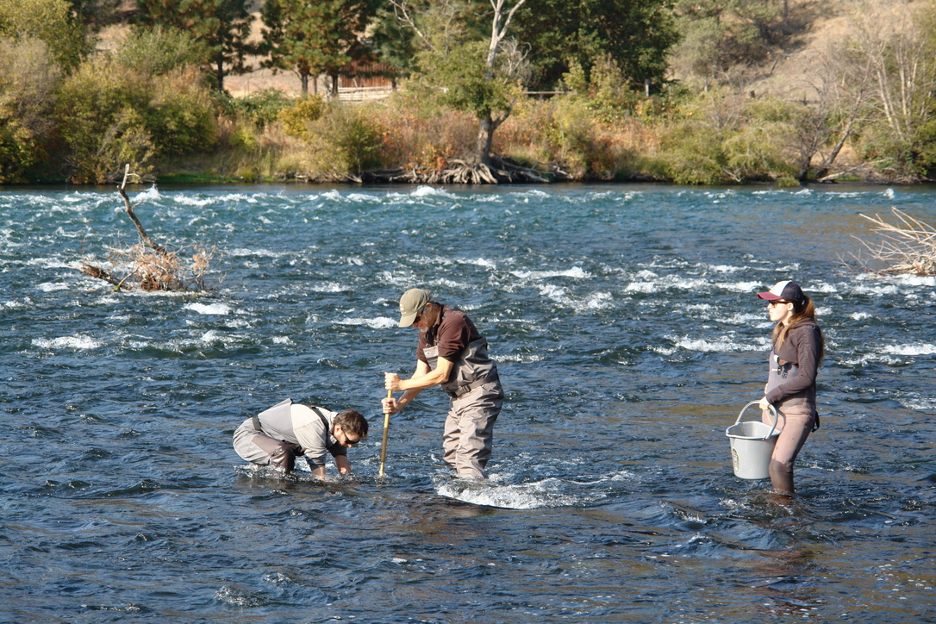
DRA Science Team at work. This year’s water quality report describes a different flow regime adapted by PGE and its effect on the lower Deschutes aquatic ecosystem.
2025 Water Quality Report Is Now Available
By Hannah Camel, DRA Science Program Lead
The Deschutes River Alliance’s 2025 Water Quality Report is now available. This marks the 11th year DRA has monitored the lower Deschutes River and shared those results with the public. Transparency is central to DRA’s mission, and our annual water quality report reflects that commitment. We strive to provide timely, accessible data and information so the public can better understand river conditions. We believe that informed communities are essential to advocating for and protecting these waters.
This year’s report evaluates observed conditions in 2025 and examines how operations of the Selective Water Withdrawal (SWW) Tower at the Pelton-Round Butte Hydroelectric Project may influence water quality and ecological conditions in the lower Deschutes River. We also expanded our monitoring program this past year with a new site near the mouth of the Deschutes, improving our ability to assess how conditions change along the river.
Key Findings
Temperature impacts remain a concern, with warming during much of the year outweighing fall cooling—particularly during critical spawning and incubation periods for salmon and steelhead.
Large daily swings in pH and dissolved oxygen continue to indicate nutrient-driven algal growth, likely linked to inputs from the Crooked River.
pH levels frequently exceeded Oregon water quality standards across monitoring sites, though some improvement was observed during periods of increased bottom-water release.
Temperature exceedances persisted, especially at downstream sites, with the Moody location experiencing the most severe conditions.
SWW operations in 2025 were notably different, with earlier and longer periods of bottom-water release than in previous years to accommodate a turbine shutoff valve replacement project.
Key Takeaways
Conditions in 2025 provided a unique opportunity to evaluate how SWW Tower operations influence pH in the lower Deschutes River. Compared to 2024, pH violations at the Warm Springs site were notably lower, suggesting a meaningful shift in system response. This difference coincided with a distinct operational pattern at the hydroelectric complex in 2025. Beginning June 25, operators initiated sustained releases of approximately 50% bottom water, continuing through August 24 before increasing to 60% bottom draw. This represents both the earliest onset and longest duration of elevated bottom-water releases since the SWW Tower became operational in 2009.
When compared to climatically similar years (e.g., 2016 and 2024), 2025 exhibited consistently lower pH values throughout much of the season. Notably, those years did not include the same early or sustained bottom-water releases. These comparisons suggest that a prolonged period of elevated bottom-water withdrawal, even at moderate levels (e.g., approximately 50% bottom draw as observed in 2025), may be more effective at reducing downstream pH than brief, intermittent periods of maximum bottom draw interspersed with lower withdrawal rates.
Climatic conditions in 2025 also provided insight into how SWW operations influence river temperature. During an early June heatwave, with air temperatures exceeding 100°F near the mouth, atmospheric heating dominated the river’s thermal regime. This period overlapped with increased bottom-water releases, allowing evaluation of cooling effects under extreme conditions.
Results indicate that increased bottom-water release generally reduces downstream temperatures, though extreme heat events can partially offset this effect. Even so, temperatures would likely have been higher without the additional cold-water input. These findings suggest that bottom draw provides important thermal relief for aquatic species, particularly during periods of elevated air temperature.
As climate change is expected to increase both average temperatures and the frequency of extreme heat events, the ability to manage river temperature through operational adjustments will become increasingly important. Overall, the data indicate that bottom-water release is a key driver of downstream thermal conditions and should be considered when evaluating temperature management strategies in the lower Deschutes River.
Learn More
Read the full report on our website to explore the data and learn more about the challenges facing the lower Deschutes and how the DRA is advocating for solutions.
If you’d prefer to skip the reading, join us on May 12 for the State of the Lower Deschutes webinar, where we’ll highlight key findings from the 2025 monitoring season along with updates on macroinvertebrates and fish populations from Rick Hafele and Steve Pribyl.
In the meantime, the 2026 monitoring season is already underway, and you can follow along with real-time data from our monitoring sites on our public portal.
More From The Blog



Subscribe the the DRA Newsletter
The Deschutes River Alliance is your focused voice to protect the lower Deschutes River, its cold water flows and the fish and wildlife that are sustained by them. We send regular emails with important data and news about the lower Deschutes River. We will not sell your contact information to others.
How to Support the DRA
Everyone wants clean, healthy water in the Deschutes River. Oregonians cherish our clean and healthy waterways to provide drinking water, wildlife habitat and recreational activities. The lower Deschutes River is a federally designated Wild & Scenic River, and a national treasure. It must be protected for the environmental and economic health of Central Oregon. By working together we can return the lower Deschutes River to full health.