DRA Fish of the Month
Start Your Summer With Steelhead
Summer Steelhead (Onchorhynchus mykiss)
Salmonid type – Salmonidae
Native species
Federal Endangered Species Act – Threatened
Oregon Sensitive Species List – Sensitive-Critical
The Science of Steelhead
By Steve Pribyl
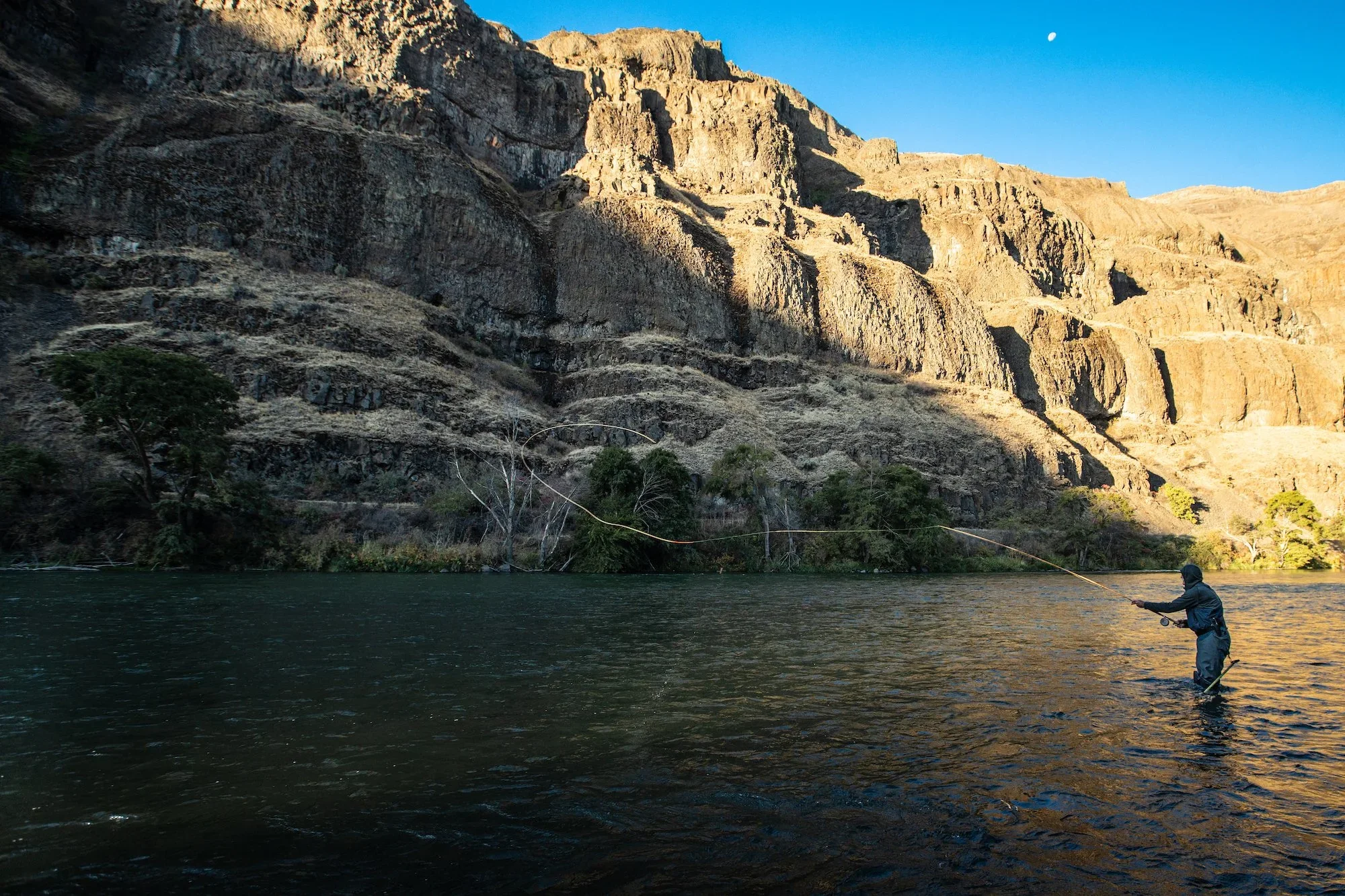
Summer steelhead are native to the lower Deschutes River. Deschutes redband trout may be the fish that made the lower Deschutes famous, but summer steelhead are a close second. Fishing for summer steelhead in the Deschutes downstream from Sherars Falls in July through October in that unique, large river and desert-like environment backdropped by the canyon scenery and wildlife is a special experience. Deschutes summer steelhead have long endeared themselves to anglers for their willingness to take a fly presented at or near the surface, and they are generally willing to bite a variety of lures.
Steelhead are rainbow trout that migrate to the ocean as juveniles and return after several years as adults to spawn. Research in the Deschutes and other places has shown that resident trout will breed with steelhead, and that both resident and anadromous variants have somewhat elastic tendencies to be either resident or anadromous.
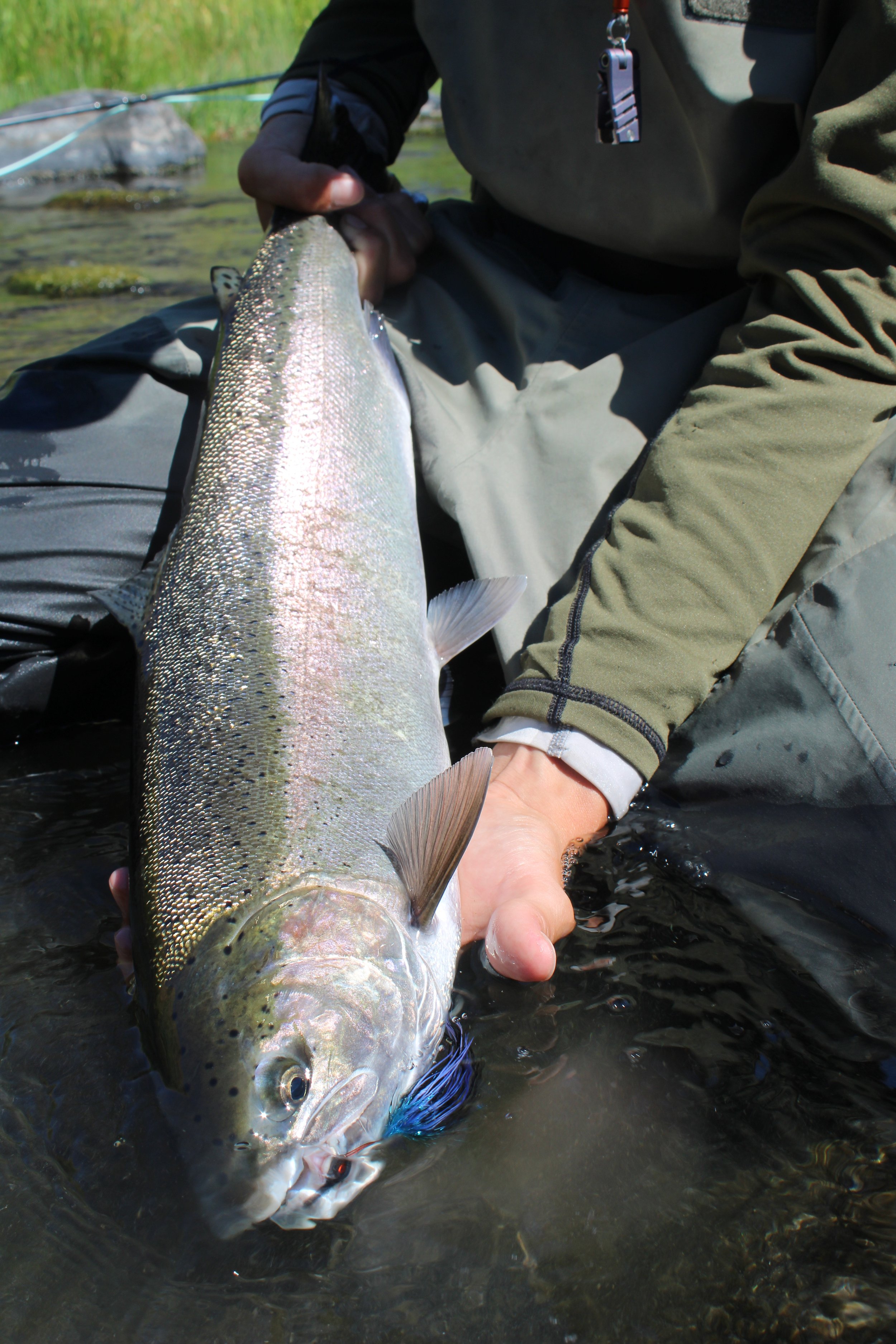
Since steelhead are rainbow trout, they have the exact same physical characteristics. Steelhead have bilaterally flattened bodies with two sets of paired fins (pectoral and ventral), a well-developed adipose fin, generally a square tail and prominent dorsal fin. An important identifying characteristic is that the anal fin has 12 or less individual fin rays as opposed to all five species of the genus Oncorhynchus that have 13 or more individual fin rays. They have dark colored spots on a light-colored background, and the lower jaw rarely extends past the rear margin of the eye, although in mature males this may happen.
Patterns of Life in the Deschutes
Deschutes summer steelhead exhibit a variety of color and spotting patterns. Summer steelhead fresh from the ocean have very silver sides and a dark blue back. The number and positioning of spots can vary, although generally not as much as in Deschutes resident trout. Both male and female steelhead in spawning color show a much more prominent red stripe along the lateral line than immature fish, especially in males. An old saying among fishermen is that the longer a steelhead is in freshwater on their spawning migration, the more they look and behave like resident rainbow and this is very much true of Deschutes summer steelhead.
This brings up the question of whether adult steelhead feed in freshwater on their upstream spawning migration. Experienced summer steelhead anglers can cite cases of either seeing steelhead feeding on aquatic insects or examining steelhead stomachs with food in them. Whether that behavior is some latent feeding response or for actual substance, curiosity or aggression remains one of angling’s great mysteries.
Wild summer steelhead in the lower Deschutes have a varied life history strategy. Juveniles will spend from one to four years in freshwater before undergoing smoltation – the physiological change that allows them to go from a freshwater environment to a saltwater environment. Two years of freshwater residency is most common. Steelhead smolts are typically larger than either spring or fall chinook smolts and are around eight inches in length. Similarly, adults return to freshwater to spawn after one to three years of ocean residency with either one or two years being most common in the Deschutes.
Hatchery vs Wild
Adult summer steelhead typically enter the Deschutes from late June through October each year and are relatively sexually immature. They overwinter in either the mainstem or migrate into tributaries to mature and spawn from February to April. Peak passage through the Oregon Department of Fish and Wildlife (ODFW) trap facility at Sherars Falls is in late September most years. Deschutes steelhead generally spawn in tributaries, and are thought to show some fidelity to either east side tributaries (Bakeoven, Buckhollow or Trout Creek) or west side tributaries (Warm Springs River or Shitike Creek). Mainstem spawning can and does take place, particularly during drought years when tributaries may be less accessible.
Adult summer steelhead runs in the Deschutes are composed of three categories – wild, Round Butte Hatchery returns, or hatchery returns from other river systems that stray into the Deschutes. Most Columbia basin hatcheries that release steelhead remove the adipose fin to identify them as hatchery origin. In order to distinguish Round Butte Hatchery releases from other facilities, an additional fin mark – either the left of right maxillary, depending on year – is also made. Wild fish are, of course, not fin marked.
Round Butte Hatchery, funded by Portland General Electric and operated by ODFW, produces summer steelhead juveniles to mitigate for steelhead lost as a result of the Pelton Round Butte Hydroelectric complex. Approximately 165,000 juveniles are released each year to meet the agreed adult mitigation obligation of 1,300 adult returns annually to the Pelton Trap, a number that is generally met.
Annual Numbers
Warm Springs National Fish Hatchery, operated by the U.S. Fish and Wildlife Service and located on the Warm Springs River upstream from Ka-Nee-Tah Resort and Spa, does not currently produce steelhead for release into the Deschutes subbasin. Water quality and quality constraints at that facility limit steelhead production.
ODFW has been operating the Sherars Falls trap annually since 1977 to collect data that allows estimates to be made of the number of each group that passes above that location. The estimated number of wild-produced summer steelhead migrating past that point has ranged from a low of 482 to a high of 9,300 for the period of record. The ODFW Lower Deschutes Subbasin Fish Management Plan sets a goal of 6,575 wild fish annually. The 15-year average from 2010 to 2015 is 2,750.
The estimated number of Round Butte Hatchery-origin steelhead passing upstream from Sherars Falls ranges from 491 to 9,557 for the period of record. The 2010 to 2015 average is 2,617. Stray, or non-Deschutes origin hatchery summer steelhead estimated to have passed Shears Falls has varied widely through time, with a low of 353 and a high of 25,263, and a 15-year average of 4,900.
The presence of stray or out of subbasin hatchery summer steelhead in the lower Deschutes is an interesting issue. There is considerable conjecture that many stray hatchery steelhead enter the Deschutes because of its large volume of cold water and position some 205 miles up the Columbia River. Previous studies have confirmed the importance of the Deschutes as a valuable cold-water refuge for upstream migrating steelhead.
There is also conjecture that the previous management scheme of trucking or barging smolts collected at upstream Columbia River dams for release below Bonneville Dam to minimize smolt losses at mainstem dams was a major contributing factor in adult straying behavior. The potential exists that trucking or barging smolts downstream inhibits their ability to find their natal stream on the return migration making straying behavior more common. Since fewer steelhead smolts have been transported downstream in the Columbia, a change made in 2010, fewer stray steelhead have been observed in the lower Deschutes, lending some validity to that thought. Changes in upstream hatchery broodstock use have also potentially ameliorated stray rates into the Deschutes.
Both the large number of stray hatchery steelhead and the documented fact that many of them tend to remain in the Deschutes potentially spawning in the wild is somewhat unique. The potential for large numbers of non-subbasin hatchery steelhead spawning in the wild with either wild or with subbasin hatchery fish is troubling from a genetic standpoint. It is likely much to the benefit of Deschutes steelhead that stray numbers have decreased from highs in the late 1990’s to early 2000’s. Steelhead fishing during the peak stray years was undeniably very good, however.
The impact to summer steelhead in the Deschutes from Selective Water tower (SWW) operations is uncertain. Adult returns are highly variable through time, but it is likely no positive benefits have accrued to steelhead from changes to water quality and temperature changes made with SWW operation. Well-documented changes in aquatic insect numbers and hatch timing are unlikely positive developments for steelhead juveniles during their one to four years of freshwater residency period. Very large increases in the number of smallmouth bass and walleye migrating from the Columbia into the lower Deschutes due to warmer water temperatures from SWW operation without a doubt contribute to increased predation of steelhead juveniles.
More From The Blog
Subscribe the the DRA Newsletter
The Deschutes River Alliance is your focused voice to protect the lower Deschutes River, its cold water flows and the fish and wildlife that are sustained by them. We send regular emails with important data and news about the lower Deschutes River. We will not sell your contact information to others.
How to Support the DRA
Everyone wants clean, healthy water in the Deschutes River. Oregonians cherish our clean and healthy waterways to provide drinking water, wildlife habitat and recreational activities. The lower Deschutes River is a federally designated Wild & Scenic River, and a national treasure. It must be protected for the environmental and economic health of Central Oregon. By working together we can return the lower Deschutes River to full health.