Steelhead Masters Inspires Crowd
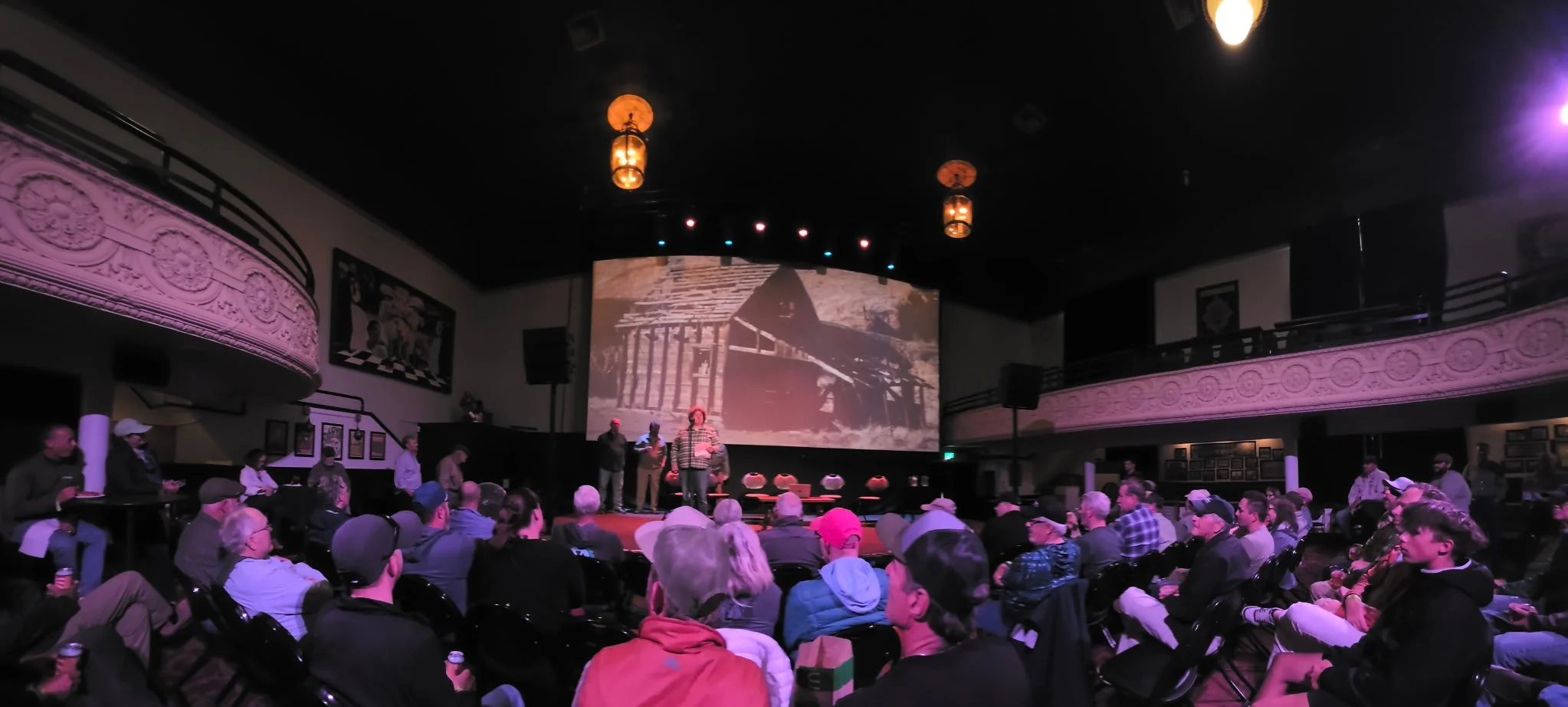
DRA Executive Director Sarah Cloud introduces the Steelhead Masters: Bill Bakke, John Hazel, Bill McMillan, Steve Pettit, and Randy Stetzer.
Emotions Run High for Steelhead Quintet
On Tuesday evening, five legends of steelhead fly-fishing in the Pacific Northwest took the stage at the Mission Theater for the DRA’s Steelhead Masters event. Bill Bakke, John Hazel, Bill McMillan, Steve Pettit and Randy Stetzer spent two hours sharing stories and photos from the quintet’s combined 250 years of experience on steelhead rivers around the region.
DRA Executive Director Sarah Cloud introduced the panel, and as she introduced John Hazel, he took to the microphone with emotions visibly stirred. “It’s such a privilege to share an evening with these four,” Hazel said. “These three–Bakke, Pettit and McMillan–those guys were our mentors. We’re all so lucky to be here tonight. This is going to happen tonight, and we should all pay close attention, because it likely will not happen ever again.”
Floating Lines and Fiberglass Rods
Bill Bakke, Steve Pettit and Bill McMillan, each in their 80’s, recalled some of the earliest days of steelhead fly-fishing from more than a half-century ago. McMillan noted that he caught his first fish on a fly in 1958. “But the real first event in my fly-fishing career came a few years later, in 1961, when I caught my first steelhead on a fly. That changed the trajectory of my life.”
The panelists recalled how, a decade after McMillan’s life-changing first steelhead, he was preaching the gospel of swinging a fly on a floating line. Steve Pettit, who presented a slide show of early days of steelheading on the Clearwater River in Idaho where he’s lived for 55 years, recalled his first steelhead set-up in 1971 was an Eagle Claw six-weight fiberglass rod with a small Pflueger reel. “I hooked 17 fish before I landed one on that outfit, and it wasn’t long after that I upgraded to an eight or nine-weight.”
John Hazel and Randy Stetzer were early to see the light of a floating line, though they each admitted it wasn’t always easy. “I remember Bill telling me ‘you don’t need a sinking line in the winter, these fish will eat a surface fly any time of year.’ And so I tried it, and went fishless in November, fishless in December, fishless in January,” Hazel said to the laughing audience.
Stetzer too had the audience laughing, recalling how persistently he and Hazel pranked each other when they were both guiding the Deschutes.
Trio Shares Hopes for Steelhead Into the Future
The trio of elders imparted some of their river wisdom toward the end of the panel discussion. When asked what advice each of them would give to a hopeful steelhead fly-fisher just getting started, Pettit mentioned the urgency to change the politics of fish restoration and protection for the better. Bill Bakke encouraged anglers to fight for rivers to be managed better for wild steelhead. Bill McMillan took a more philosophical approach. He said, “Learn that fishing is a way to connect you to nature. Pay attention to what you see. The birds, the trees, the fish, everything you see, are trying to tell you something about themselves. They’re also trying to tell you something about you, about yourself. Fish in a way that respects the river, but works for you. Don’t listen to anybody else. It should never be a competition, but a way of seeing the world that makes you appreciate it more.”
The panelists received an enthusiastic standing ovation at the end of the evening.
Professional videographer Jim Stanek recorded the Steelhead Masters event, which will soon be available on the DRA’s website.
More From The Blog
Subscribe the the DRA Newsletter
The Deschutes River Alliance is your focused voice to protect the lower Deschutes River, its cold water flows and the fish and wildlife that are sustained by them. We send regular emails with important data and news about the lower Deschutes River. We will not sell your contact information to others.
How to Support the DRA
Everyone wants clean, healthy water in the Deschutes River. Oregonians cherish our clean and healthy waterways to provide drinking water, wildlife habitat and recreational activities. The lower Deschutes River is a federally designated Wild & Scenic River, and a national treasure. It must be protected for the environmental and economic health of Central Oregon. By working together we can return the lower Deschutes River to full health.