Where is the Cold Water in the Lower Deschutes Cold Water Refuge?
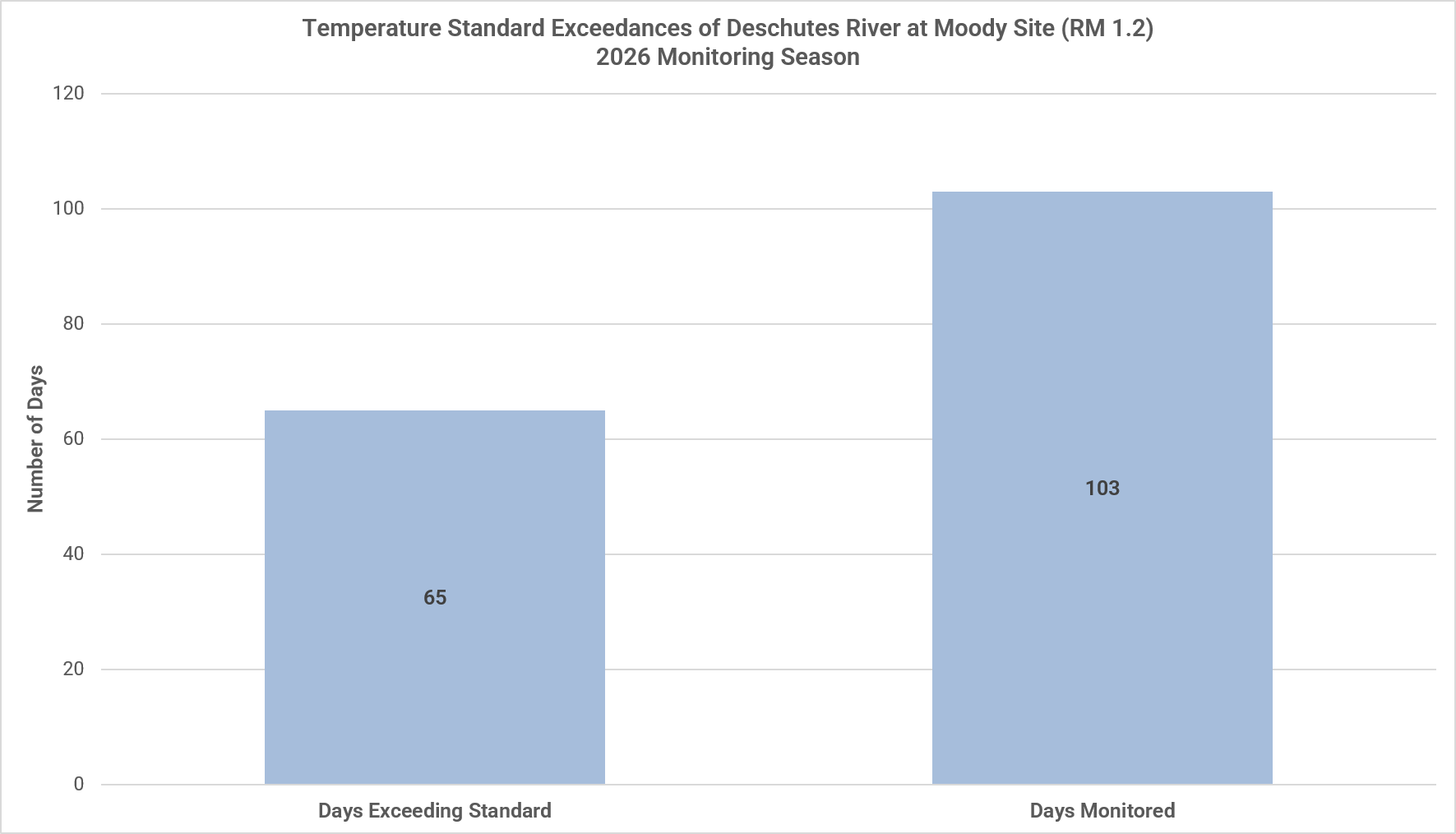
More than half of the days since April, water temperatures at Moody do not meet the state temperature standard.
Keeping Fish Cool?
“The 2025 temperatures in Round Butte forebay were mostly consistent with 2010-2024 temperatures. Since SWW operation began, the reservoir has experienced warmer water than the temperature modeling data predicted and thus, has had less cold water in the blend to help meet the calculated without Project (WPT) discharge target temperature.”
-Excerpt from PGE’s June 2026 annual water quality report to the Federal Energy Regulatory Commission.
“As part of the Pelton Round Butte Project water quality and management plan, consider the temperature effects of the selective water withdrawal operations on the Deschutes River CWR. Specifically, consider maximum sub-surface cool water blend (60%) in August and September to help maintain temperatures below 18 C when CWR [cold water refuge] use is highest.”
-Recommendations for Deschutes River management from a 2021 E.P.A. report on Cold Water Refuges in the Columbia Basin
Cold Water for Upper Columbia Basin Salmon and Steelhead Should be in the Lower Deschutes
The lower Deschutes River’s designation as a vital cold water refuge is at risk. Losing it could not only negatively impact Deschutes fish, but salmon and steelhead throughout the upper Columbia Basin.
According to a 2021 report from the Environmental Protection Agency, 16%-26% of upriver traveling steelhead headed to their home waters in eastern Oregon, Washington and Idaho– utilize the Deschutes, particularly the lower three miles before its confluence with the Columbia, as a reprieve from hot water on their way upriver. During three years of research to inform the EPA document, it was shown that 26,000 to 30,000 upriver-migrating steelhead utilized the cold water refuge in the lower Deschutes on their upstream migration.
EPA’s study designates the lower Deschutes as one of the most important cold water refuges in the Columbia Basin. Fish migrating upstream don’t find any other cooling water until they migrate above McNary Dam, 90 miles upstream. Losing access to this refuge could have especially far-reaching consequences for fish in a drought year like this.
While this summer’s drought intensifies, Portland General Electric (PGE), which operates the three-dam complex on the Deschutes, is sitting on an ample supply of cold water that could ameliorate some of the thermal stress fish will face this summer in the Columbia.
Some background: since 2010, when PGE began operating its Selective Water Withdrawal (SWW) Tower, warm surface water from the reservoir behind Round Butte Dam, Lake Billy Chinook, has comprised the vast majority of the lower river’s flow. The SWW was designed to mix water from different depths in the reservoir to supposedly mimic the temperature regime of the lower Deschutes before the dams were in place, and make it possible for juvenile anadromous fish to find the dam and trap. It was forecast to improve water quality in both the reservoir and the lower river, providing a boost to salmon and steelhead reintroduction above the dams.
But the blend of surface and deep water hasn’t accomplished the stated goal of improved downstream water quality.
In fact, for eight months out of the year, from November through June, no blending occurs: one hundred percent of the flow of the lower Deschutes is warmer reservoir surface water. Sometime in June or July, Portland General Electric (PGE) begins incrementally mixing cold water from the depths (250 ft.) of Lake Billy Chinook with warmer surface water.
The maximum percentage of water from the depths of the reservoir: 60%. Yet the original operations plan for the SWW were supposed to allow for 100% bottom water withdrawal. For reasons PGE has never explained, the current configuration of the SWW isn’t capable of withdrawing 100% 50-degree Fahrenheit water from the reservoir’s depths. Limited to 60% cold water, (always mixed with 40% warm surface water) maintaining a cold water refuge at the mouth of the Deschutes 100 miles downstream–especially in the summer months is difficult if not impossible to achieve.
PGE has tools at its disposal to accomplish this, but for reasons the utility giant has never revealed, refuses to deploy them. (More on that in a bit.) In a drought year like 2026, this refusal to consider alternative management schemes puts aquatic life and the vital Deschutes cold water refuge at risk. It also sheds some heat on a false narrative PGE has constructed around operations of the SWW.
The primary rationale PGE gives for not putting the maximum amount of cold water into the lower Deschutes is that the supply is limited. “Since SWW operation began, the reservoir has experienced warmer water than the temperature modeling data predicted and thus, has had less cold water in the blend to help meet the calculated without Project (WPT) discharge target temperature,” states PGE’s 2026 water quality report to FERC. But there isn’t much evidence to support this claim.
From 1964 until 2010, 100% of the flow into the lower Deschutes, every day of the year, was composed of water from the depths of Lake Billy Chinook. There’s no record of any year in that period when officials from PGE or relevant state agencies expressed concerns about running out of cold water stored 250 feet deep in the reservoir.
Logically, if the maximum cold water withdrawal now is 60%, even if that maximum flowed out if the reservoir and into the Deschutes year-round, exhausting the supply in any given year doesn’t seem a likely scenario. It seems even less likely since the 60% maximum now is applied just several weeks a year.
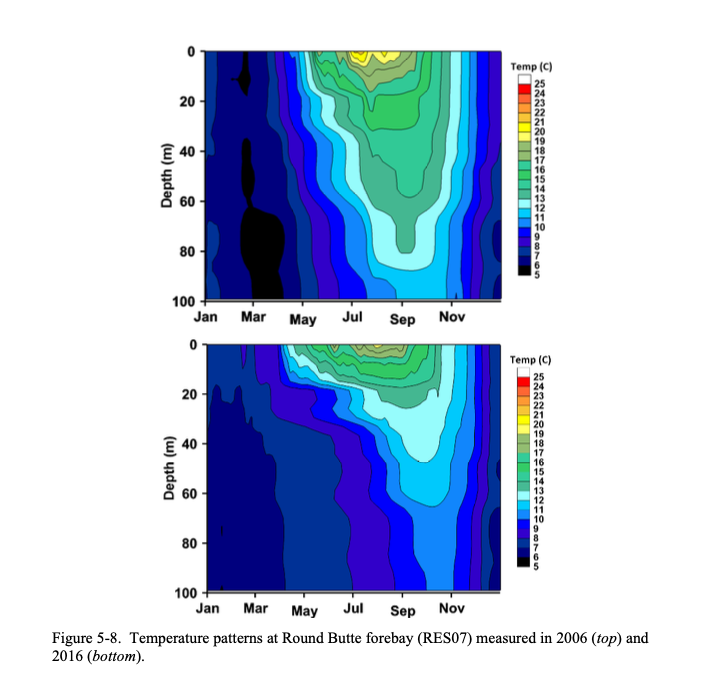
Pre- and post-SWW temperature mapping of Lake Billy Chinook in the forebay confirms that the supply of water at depth has changed, but only slightly:
u
PGE: Continue the Status Quo
The graphic (above) also shows this: under current operation, water temperatures at depth in the forebay of Lake Billy Chinook year around do not exceed 12 C., or 53.6 F. There is an adequate supply of cold water available for downstream release.
While a deep pool of cold water lies at depth in Lake Billy Chinook, underutilized in a drought season, PGE reported to FERC last month that other than some possible small adjustments to the summer flow regime, no major changes in operations are planned. Which likely means that even in a low-flow, hot summer, PGE’s efforts to cool the river will come too little, too late.
The DRA’s water quality monitoring program has already recorded 65 of 103 days in violation of the state temperature standard at its Moody station, situated in the midst of the designated cold water refuge. Flows are at or near record lows for early July, with the bulk of summer heat still ahead.
The DRA is advocating for change: maximum withdrawal (60% bottom water) year-round, with the exception of the March to June time period, when juvenile steelhead and salmon are migrating through Lake Billy Chinook.
The lower Deschutes River needs to flow with the maximum amount of cold, clean water, not only for the sake of Deschutes River trout, salmon and steelhead, but for the protection of upstream migrating salmonids in the upper Columbia Basin.
More From The Blog

Subscribe the the DRA Newsletter
The Deschutes River Alliance is your focused voice to protect the lower Deschutes River, its cold water flows and the fish and wildlife that are sustained by them. We send regular emails with important data and news about the lower Deschutes River. We will not sell your contact information to others.
How to Support the DRA
Everyone wants clean, healthy water in the Deschutes River. Oregonians cherish our clean and healthy waterways to provide drinking water, wildlife habitat and recreational activities. The lower Deschutes River is a federally designated Wild & Scenic River, and a national treasure. It must be protected for the environmental and economic health of Central Oregon. By working together we can return the lower Deschutes River to full health.