Four Questions on the Steelhead Closure
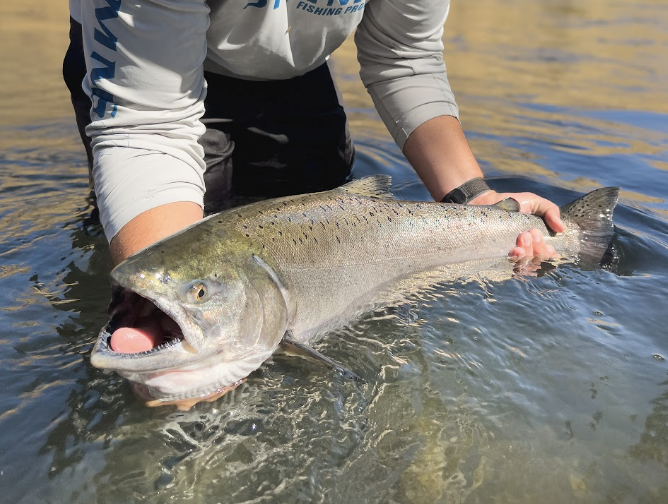
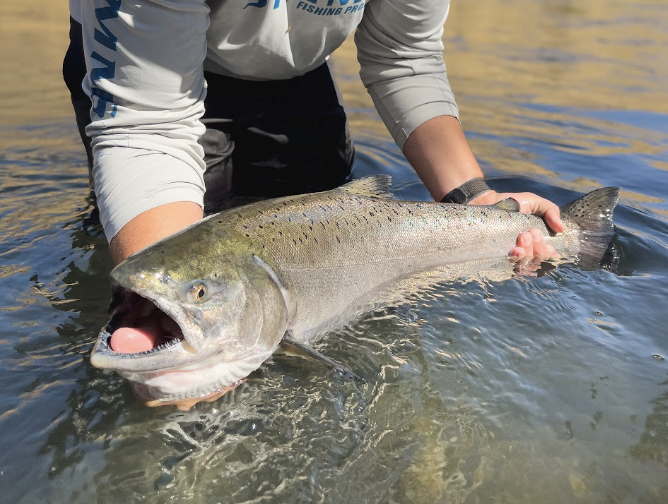
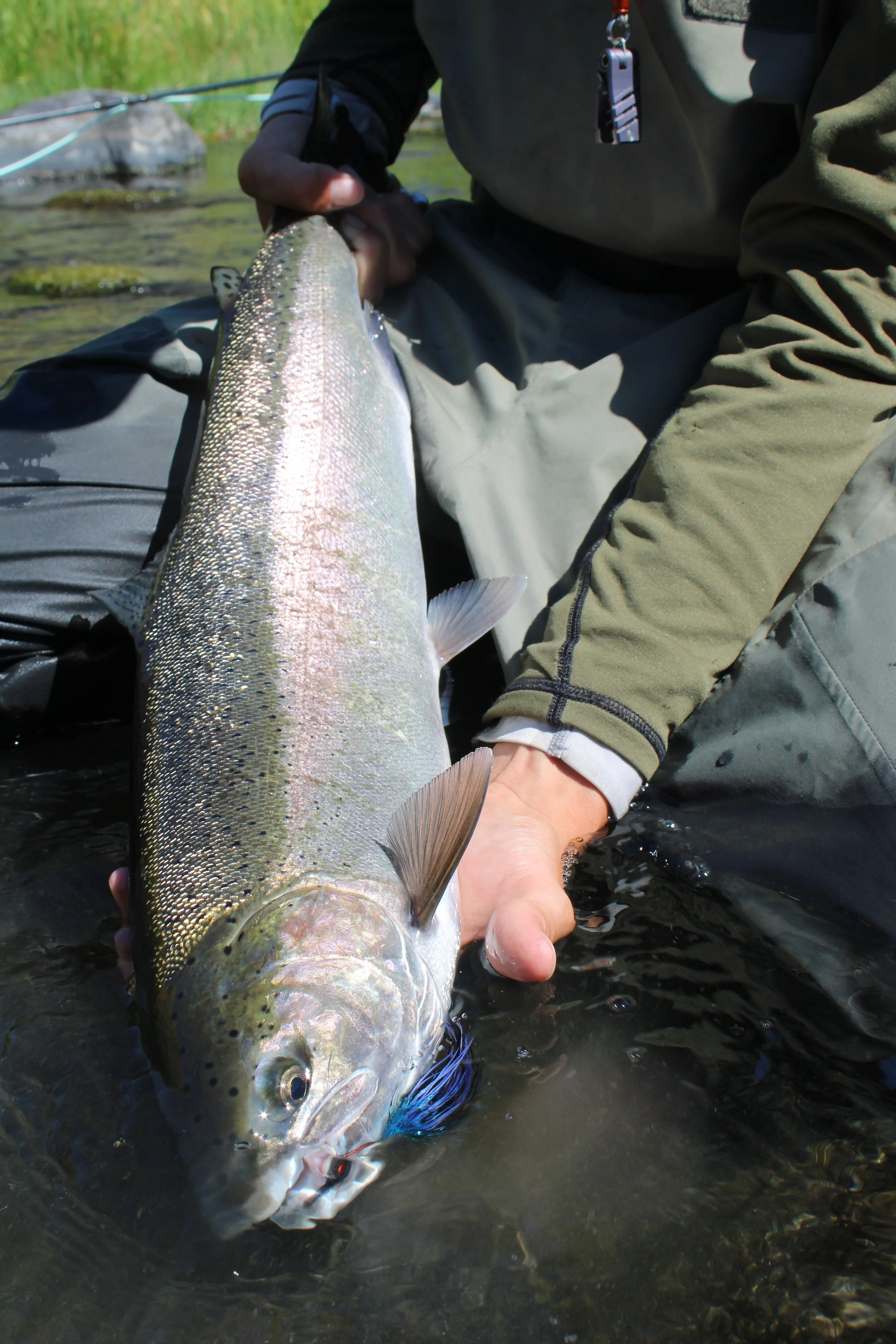
Better days: a wild steelhead brought to hand, ready for release back into the Deschutes. Photo courtesy of Ryan Ball.
The steelhead closure on the Deschutes River remains in effect. The closure prompted staff at the DRA to research the status of wild steelhead, both in the Columbia, where counts over Bonneville Dam determine whether there will be a season, and in the Deschutes Basin. The information gathered will inform future actions that we hope will improve the prospects for steelhead, and decrease the odds of future closures. In four questions, here’s some highlights from our research.
1.What does a steelhead closure cost?
Unfortunately, no one has crunched these numbers, but there is a basis for at least a rough comparison. In 2019, facing a truncated steelhead season, the Idaho Department of Labor estimated the cost to a five-county area surrounding the Clearwater River at $8.2 million per month. Over the course of a five-month season, the annual loss was estimated at over $40 million. That’s $52 million in 2026 dollars.
2. What does the correlation between wild steelhead over Bonneville Dam and into the Deschutes tell us?
Let’s start with the numbers at Bonneville from July 1st to August 31st, which determine whether the Deschutes steelhead season stays open:
Ten-year averages, wild steelhead passage at Bonneville Dam, 7/1-8/31
2006-2015: 86,376 2016-2025: 34,148
Percent decline between decades: 60.4
By any standard, the last ten years have been rugged for wild steelhead in the Columbia Basin. As bad as a 60% decrease looks, the Deschutes was worse. Deschutes steelhead are counted by ODFW from June 1st of one year, to May 31st of the following year, which is why two calendar years are listed as end points between each decade.
Ten-year averages, wild steelhead escapement into the Deschutes:
2005/2006 to 2014/2015: 4,467 2015/2016 to 2024/2025: 1,558
Percent decline between decades: 65.1
3. For full life-cycle survival rates, how does the Deschutes compare to other steelhead tributaries in the mid-Columbia River Basin?
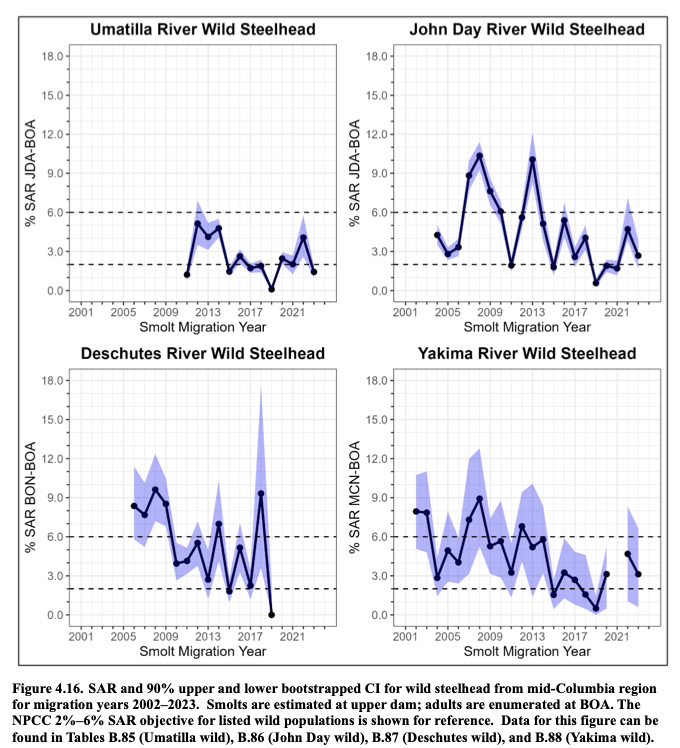
Graph from The Fish Passage Center’s 2026 draft Comparative Survival Study.
This graph, from the Fish Passage Center’s draft 2026 Comparative Survival Study annual report, depicts smolt-to-adult (SAR) ratios in The Deschutes, Yakima, Umatilla, and John Day Rivers. SAR is a metric used to measure full life-cycle survival rates in a cohort of anadromous fish. According to the Northwest Power and Conservation Council, a two to six percent SAR is the goal for rivers in the Columbia Basin, with four percent as the target to restore depleted populations. While none of the four tributaries’ SAR’s are trending in the right direction, only the Deschutes’s SAR between 2017 and 2021 dropped from well above the two to six percent target rate to below two percent. Below two percent, Deschutes River wild steelhead are not reproducing at a rate high enough to maintain current population levels.
4. How does poor water quality in the Deschutes River potentially affect steelhead?
The DRA has been monitoring water quality in the lower Deschutes River since 2016. Each year’s data is summarized in our annual water quality report. Violations of pH, dissolved oxygen and temperature occur daily. Here’s a quick summary of how these violations can affect steelhead productivity:
pH
pH levels above 8.5 cause stress, exhaustion and osmoregulatory ( internal salt/water balance) failure in juvenile steelhead. Ongoing, daily violations of the state pH standard represent a risk for both juvenile and adult hatchery and wild steelhead. For juveniles, high pH increases the amount of unionized (uncharged, dissolved gas form) of ammonia. These uncharged particles pass easily through the gills, particularly of juvenile fish, causing damage from toxicity. High pH (alkaline) water burns away the protective slime on fish, as well as damages gill tissues, depriving them of oxygen and increasing susceptibility to disease.
Temperature
Temperatures above 68F (20C) stress steelhead and salmon, creating a higher risk of disease and related mortality. Temperatures above 70F (21.1C) create a lethal migration barrier. Temperatures above 73F (22.7C) cause direct mortality.
Dissolved Oxygen
Low levels of dissolved oxygen can cause embryos to hatch prematurely, physical deformity and abnormal growth. Emerging fry in low-oxygen water tend to be smaller and less active.
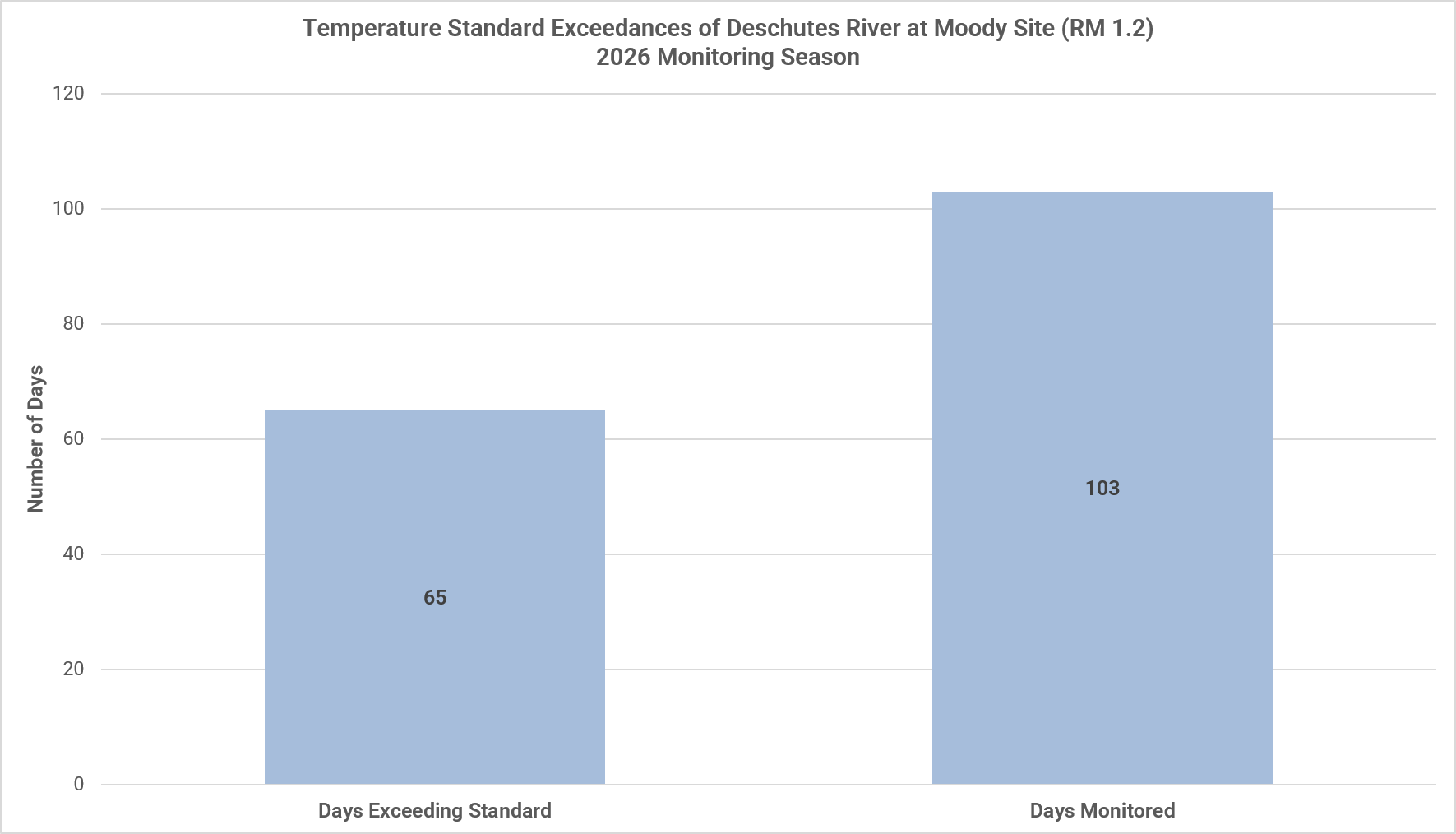
In 2026, the state standard for pH was violated 103 out of 165 days monitored near Warm Springs, 123 out of 165 days near Maupin, and 174 out of 174 days near Moody. Temperature violations at Moody have been recorded 125 out of 174 days.
From June to October, more stringent standards apply on the Deschutes to protect spawning and rearing. From the DRA’s 2025 water quality report, here’s a graph comparing the number of temperature violations, before and after the Selective Water Withdrawal Tower went into operation:
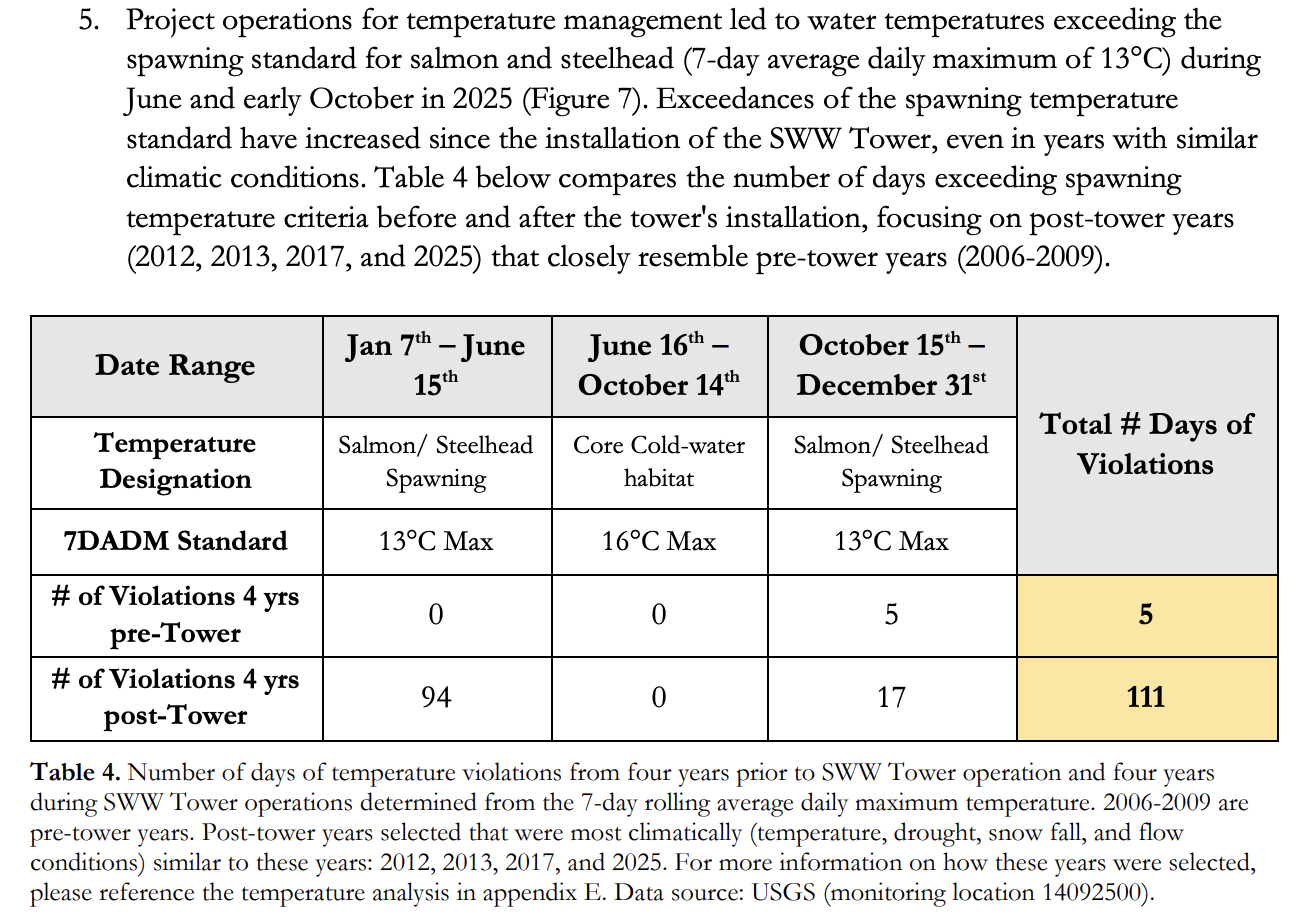
Graph from the DRA’s 2025 Water Quality report, depicting pre- and post-Tower frequency of temperature violations.
To avoid future steelhead closures, the Deschutes River needs more wild steelhead. Poor water quality may be the biggest obstacle to achieving this goal. But it’s also a problem with a tangible fix: the DRA’s data shows that water quality parameters come into compliance when colder, cleaner water is released into the lower river. The DRA’s call for a three-year experiment of the maximum amount of cold water from the depths of Lake Billy Chinook would likely be a big help with the campaign to save steelhead season.
More From The Blog
Subscribe the the DRA Newsletter
The Deschutes River Alliance is your focused voice to protect the lower Deschutes River, its cold water flows and the fish and wildlife that are sustained by them. We send regular emails with important data and news about the lower Deschutes River. We will not sell your contact information to others.
How to Support the DRA
Everyone wants clean, healthy water in the Deschutes River. Oregonians cherish our clean and healthy waterways to provide drinking water, wildlife habitat and recreational activities. The lower Deschutes River is a federally designated Wild & Scenic River, and a national treasure. It must be protected for the environmental and economic health of Central Oregon. By working together we can return the lower Deschutes River to full health.