Fish of the Month: From Sculpin to Stickleback: the Ones You Usually Don’t See
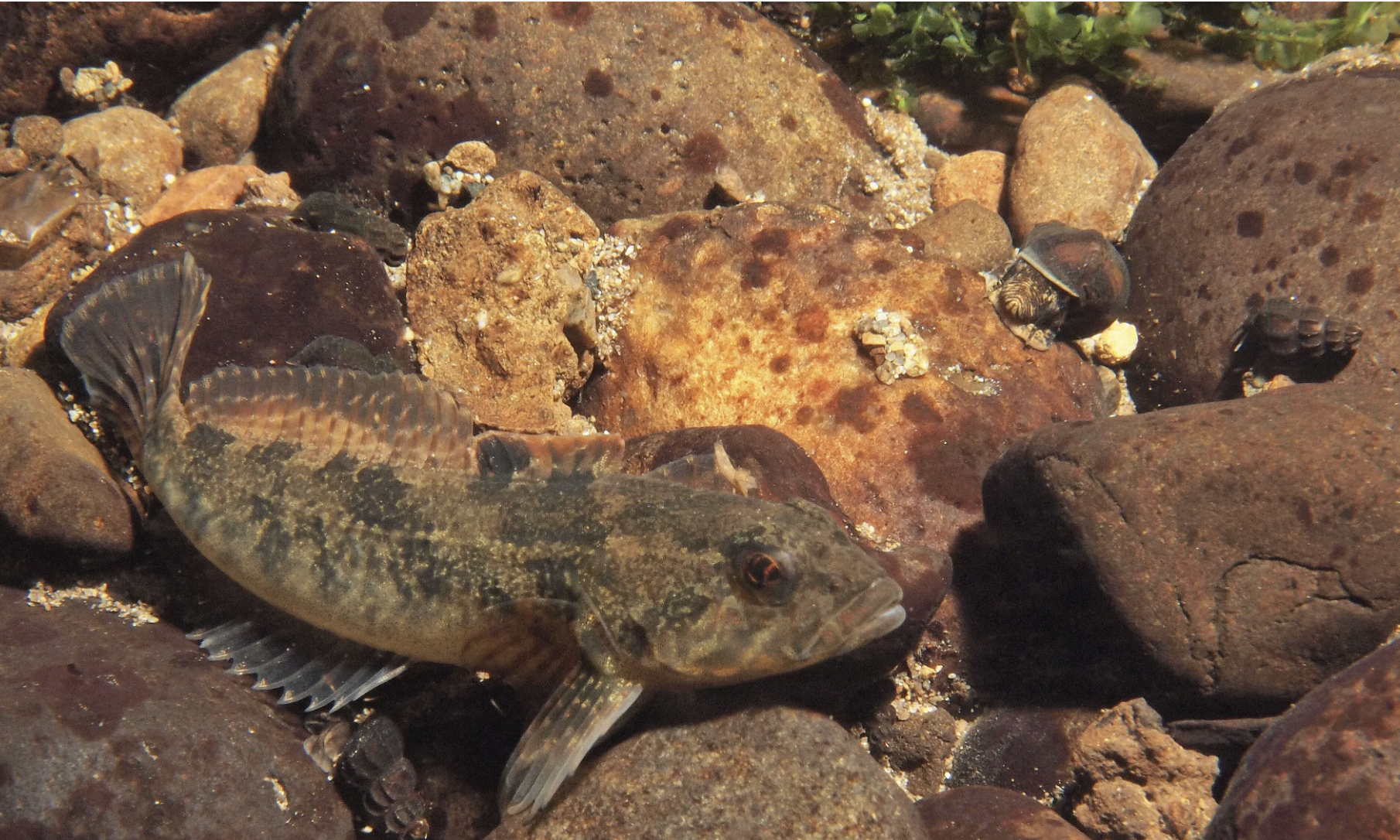
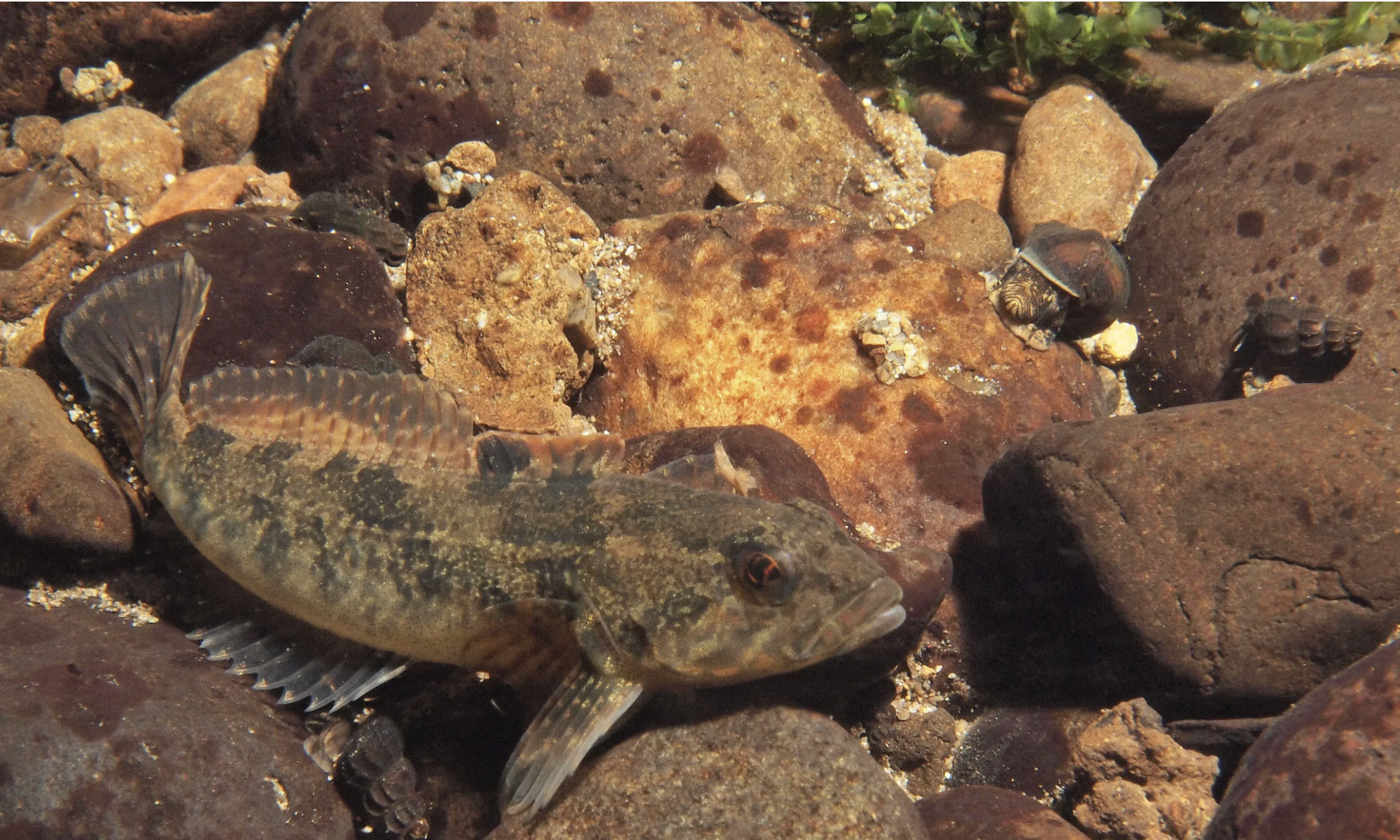
Laying low: A riffle sculpin, eeking out a living in the shallows.
And the Ones You Don’t Catch as Often
By Steve Pribyl, DRA Board Member, ODFW Biologist (Retired)
The lower Deschutes has a rich and varied assemblage of anadromous fish. Summer steelhead, spring Chinook, fall Chinook, sockeye and coho adults that return each year on their annual upstream spawning migration. The famous Deschutes redside trout or redband rainbow are sought-after year-around residents. But the lower Deschutes is also home to an equally rich and diverse group of less visible and famous native fish. Most of these residents go unseen by the average fisherman.
Sculpin (Family Cottidae)
Sculpin have a very unusual shape compared to everything else in the Deschutes. Simply put, they look like a rockfish from the ocean – very large mouth, fan-like pectoral fins, prominent two-part dorsal fins that may or may not have a spiny section and are generally brownish in coloration with prominent darker bars, blotches or stripes. They are small bottom dwellers that are difficult to observe unless it's hanging out the mouth of a redband trout, which does happen. For as big as they get, they are surprisingly long-lived with various species reported to live five to seven years. Some ichthyologists (people that study fish) have spent literally their whole careers studying the taxonomy of freshwater sculpin and their identification to species level can be challenging for the casual observer. There are likely two or three species in the lower Deschutes – Pauite sculpin (Cottus beldingii), riffle sculpin (Cottus gulosus) and torrent sculpin (Cottus rhotheus).
Suckers (Family Catostomidae)
There are two species of suckers in the lower Deschutes – largescale (Catostomus macrocheilus) and bridge lip (Catostomus columbianus). Both share the same round and weight-forward sucker-like body shape and the subterminal or downturned mouth used to rasp periphyton from rocks. The largescale sucker is the larger of the two species and adults can weigh four or five pounds. They have a general bronze to orange coloration on top with a lighter belly. Largescale suckers have a large and often whitish anal fin. Bridgelip suckers have a more muted brown and tan coloration and rarely exceed 16 inches in length.
Northern Pikeminnow (Family Leuciscidae)
The northern pikeminnow (Ptychocheilus oregonensis) is native to the Deschutes and widely distributed across northwestern North America. They lack an adipose fin, but the paired fins and dorsal have the same body position and body shape as salmonids. They have a deeply forked tail. Pikeminnow have a silvery or olive-green body often with prominent gold-yellow highlights and a large, terminal mouth that extends past the eye. There are no visible teeth. A mature adult can weigh up to five pounds and tend to strike a bait hard and fight like demons. Pikeminnow are a voracious predator of other fishes and are the subject of the long running sport reward or bounty program on the mainstem Columbia to both decrease their number and the proportion of large adults that are very effective predators on downstream migrating juvenile salmonids. Since these fish are predators, Deschutes anglers do occasionally catch pikeminnow.
Chiselmouth (Family Leuciscidae)
Named for the sharp, hard plate on its lower jaw, chiselmouth (Gila alutaces) are also native to the Deschutes. Sharing the same family as northern pikeminnow, they look similar and have the same body shape, fin paring, deeply forked tail but commonly have orangish paired and anal fins. Chiselmouth are not predatory but rasp periphyton off bottom rocks and their mouth is slightly subterminal. They are not as large as pikeminnow with an adult typically less than 16 inches long. You very occasionally catch one while swinging a steelhead fly in the summer.
Peamouth (Family Leuciscidae)
Widely distributed across western North America, peamouth (Mylocheilus caurinus) share many outward features with northern pikeminnow and chiselmouth. Their mouth size and position is a bit of a cross between those species but a distinguishing feature is a small barbel at each mouth corner. Males take on a reddish strip during spring spawning leading to the localized name of redhorse. Their diet is also a bit of a cross between pikeminnow and chiselmouth and feed on a variety of aquatic insects, snails and small fishes and will readily take both submerged and floating flies. Northern pikeminnow and peamouth do hybridize; this writer has caught them in the Deschutes.
Dace (Family Leuciscidae)
At least two species of dace are native to the lower Deschutes – longnose (Rhinichthys cataractae) and speckled (Rhinichthys osculus). Leopard dace (Rhinichthys falcatus) may also be present. All are small, very inconspicuous fishes, commonly less than three or four inches that are rarely seen without specialized sampling gear. They have the same general shape as suckers, but lack the true subterminal mouth, but at least the longnose dace has a barbel at each mouth corner. They feed on aquatic invertebrates and periphytons. Every predatory fish in the lower Deschutes probably utilizes them as a food source.
Redside shiner (Family Leuciscidae)
Widely distributed across western North America, redside shiners (Richardsonius balteatus and several subspecies) are small, rarely exceeding three inches but are a surprisingly handsome fish. Somewhat more bilaterally flattened than other members of the family, they are silvery with a small red/gold stripe extending along the lateral line. The mouth is terminal with no teeth or mouth corner barbels. The tail is deeply forked, and the anal fin has between 10 and 24 rays, generally more than either trout or Pacific salmon. This is another fish that is both hard to observe and likely an important food source in the Deschutes.
Three spine stickleback (Family Gasterosteidae)
Though widely distributed circumglobally through both inland and coastal waters in northern latitudes, three spine stickleback are not native to the lower Deschutes. They were illegally introduced into at least one Deschutes reservoir south of Bend, apparently in the hope they would be a forage species for bass. They have drifted downstream and are now present in the lower river. True to their common name, they have three prominent and sharp spines in their dorsal fin although the rearmost one is commonly much smaller than the others. The pelvic or ventral fins consist of one spine and one soft ray. All spines can be locked in an erect position as a defensive mechanism. They are small, rarely exceeding two inches.
Threespine stickleback are a very interesting and widely studied fish due to their elaborate nest building and courtship behavior, and the fact that they have both freshwater and anadromous life history variants. One would have to look long and hard to find one in the lower Deschutes, however, given their very small size.
White sturgeon (Family Acipenseridae)
Under the believe-it-or-not category, white sturgeon (Acipenser transmontanus) are found in the lower Deschutes, at least downstream from Sherars Falls. More than a few have been caught by either hook and line anglers using bait while fishing for anadromous species at Sherars Falls or by tribal dipnet fishers there. This makes some sense, as they are common in the Columbia and elsewhere along the west coast, but to migrate upstream in the high gradient Deschutes must take one determined sturgeon. White sturgeon don’t look like any other fish, so a detailed description is not required. If you find one in the Deschutes, you’ll know what it is.
Pacific Lamprey (Petromyzontidae)
Pacific three tooth lamprey (Entosphenus tridentatus) are native to the Deschutes and culturally very important to tribal members in the region. Considered one of the First Foods, lamprey, commonly called eels by tribal members, are collected and utilized by tribal members at Sherars Falls. This writer has eaten tribally prepared eel on several occasions. They are rich and oily, probably a very important source of nutrition during pre-European times.
Pacific three tooth lamprey look like an eel and not a fish. You won’t mistake them for anything else. They have a fascinating life history, with juveniles spending up to seven years in freshwater going through several metamorphic changes and habitat preferences. They are filter feeders as juveniles, migrate to the ocean where they adopt a parasitic lifestyle, attaching to and feeding on a variety of fishes and mammals with their jawless, sucker-like mouths in the marine ecosystem. Upon maturation in the ocean, they swim upstream to spawn but do not necessarily show the same fidelity to their birth stream as other anadromous fishes. Rather, lamprey are known to key in on the scent of a particular bile acid they put off, and lamprey tend to attract other lamprey more so than seen in other fishes.
Outside of visiting the Sherars Falls fish ladder after dark with a flashlight, adult lamprey are rarely seen in the Deschutes. Being anadromous and long lived, Pacific three tooth lamprey suffer from many of the same problems that affect other Columbia basin fishes, and their future is as uncertain as salmon and steelhead.
More From The Blog



Subscribe the the DRA Newsletter
The Deschutes River Alliance is your focused voice to protect the lower Deschutes River, its cold water flows and the fish and wildlife that are sustained by them. We send regular emails with important data and news about the lower Deschutes River. We will not sell your contact information to others.
How to Support the DRA
Everyone wants clean, healthy water in the Deschutes River. Oregonians cherish our clean and healthy waterways to provide drinking water, wildlife habitat and recreational activities. The lower Deschutes River is a federally designated Wild & Scenic River, and a national treasure. It must be protected for the environmental and economic health of Central Oregon. By working together we can return the lower Deschutes River to full health.