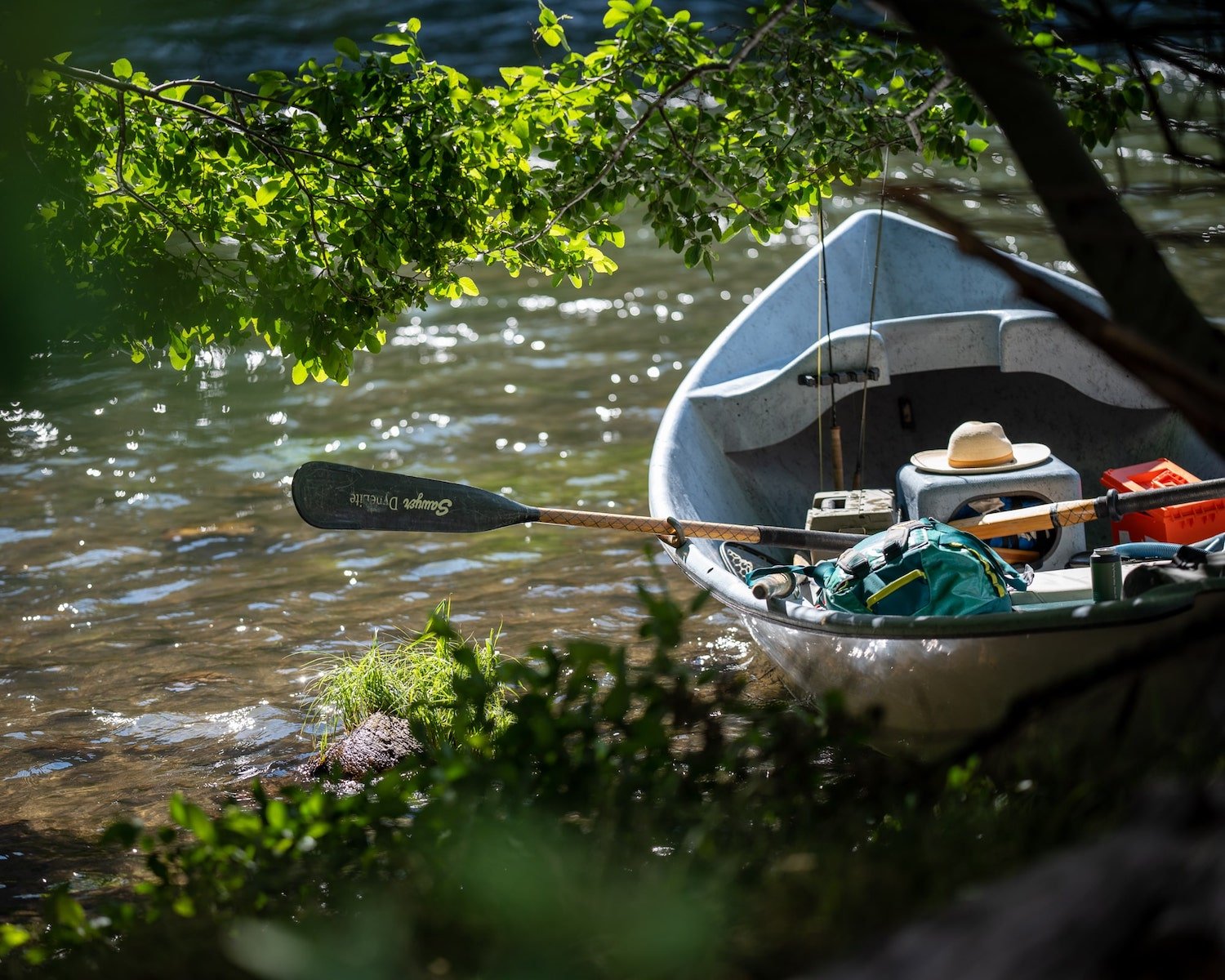
Bug of the Month: October Caddis
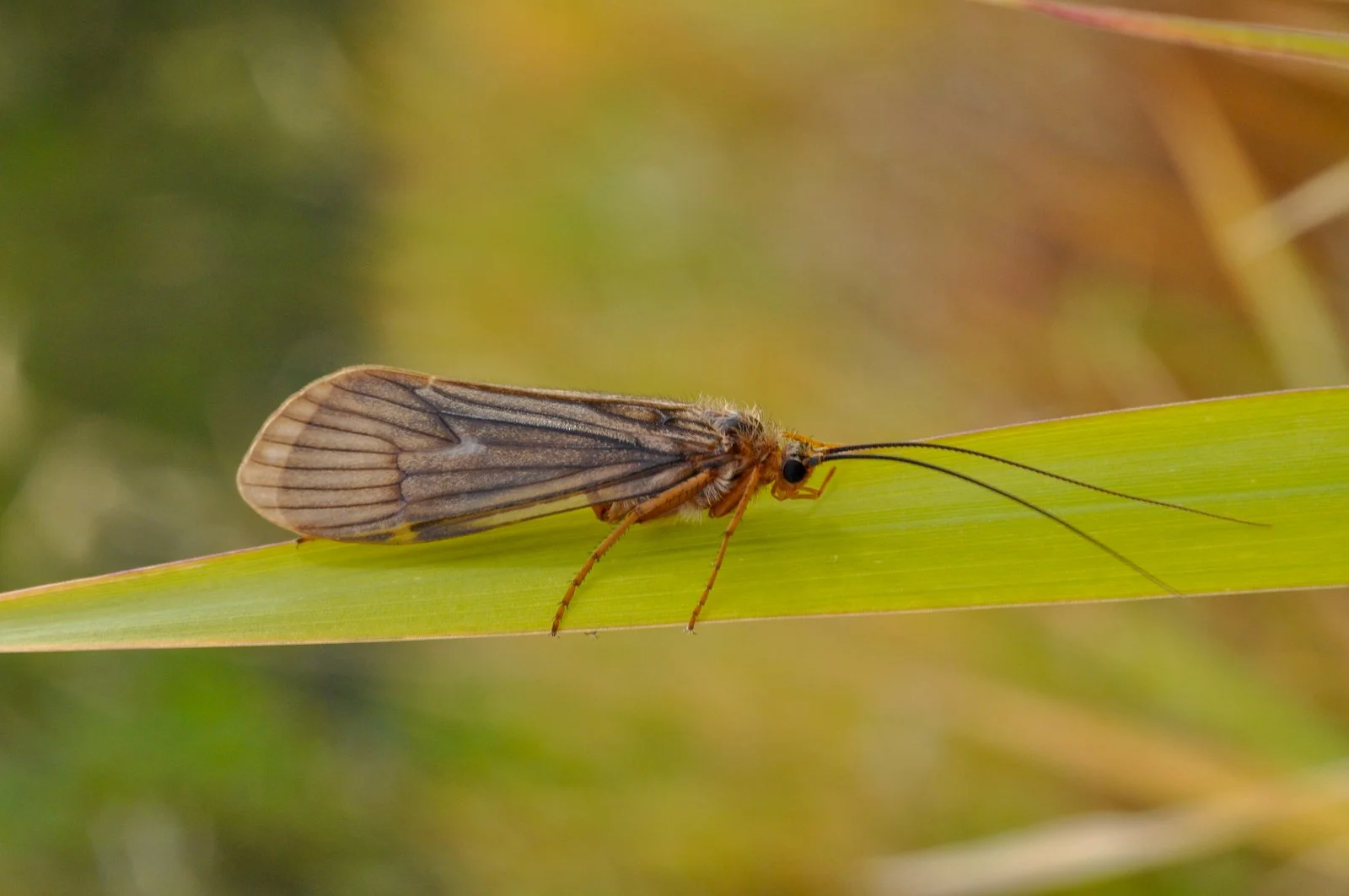
What goes with fall better than the World Series, crisp apples, and chilly sunlight? If you’re an angler, the answer is obvious. Dicosmoecus gilvipes, the October Caddis. Photo courtesy of Rick Hafele.
After the Bugs of Summer Are Gone
By Hannah Camel, DRA Science Program Lead
We’re back with another installment of the Deschutes River Alliance’s Bug of the Month series! Throughout 2026, we’ve been shining a spotlight on the aquatic insects that help make the lower Deschutes River such a remarkable fishery. Each month, we dive into the life history, habitat, seasonal timing, and abundance of a different species, while incorporating insights from the DRA’s water quality and macroinvertebrate monitoring programs. And because knowing the bugs is only half the fun, we also share guide-approved fly patterns and practical fishing tips to help you put that knowledge to use on the water.
The leaves are falling, pumpkins are out, and cooler weather is settling into the Deschutes Canyon; it can only mean one thing: fall is here. And few aquatic insects capture the season quite like this month’s featured bug, the October Caddis. True to its name, this large and unmistakable caddisfly makes its appearance as autumn takes hold, adding a splash of orange to the river just as the leaves begin to do the same.
As one of the last major insect hatches of the year, and one of the largest caddisflies found on the lower Deschutes, the October Caddis is hard to miss. Its emergence provides trout with one more opportunity for a substantial meal before winter settles in, while giving anglers a final chance to hit the water before the season winds down. This month, we’ll take a closer look at the fascinating life cycle of the October Caddis, where and how it lives, what DRA monitoring tells us about its presence in the lower Deschutes, and, of course, how to imitate it when these big orange bugs start showing up along the river.
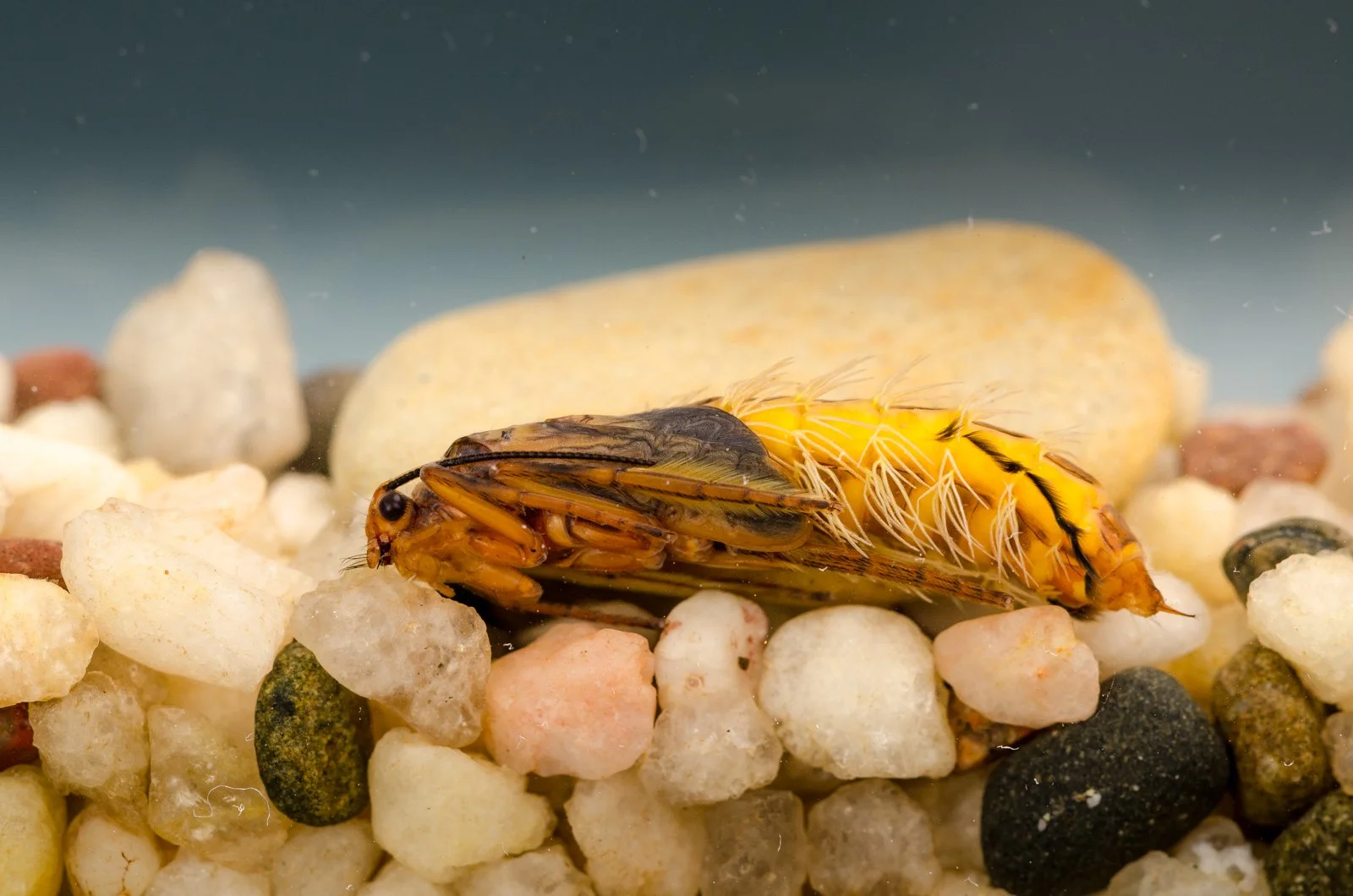
This is an October Caddis Pupa. After spending four to six weeks sealed inside its larval case, the mature pupa (pictured above) leaves the case, and scrambles across the stream bottom until it finds a place to crawl out above the water, where the adult then emerges. This is what you want your pupa pattern to look like! Photo courtesy of Rick Hafele.
Life History and Habitat
The October Caddis (Dicosmoecus gilvipes) belongs to the family Limnephilidae, one of several families within the order Trichoptera, commonly known as caddisflies. Limnephilidae is the largest caddisfly family in North America, with more than 300 species. That may sound like a lot of bugs to keep straight, but luckily for us, the October Caddis is pretty easy to recognize. On the lower Deschutes, Dicosmoecus is the only Limnephilidae taxon we regularly encounter in our monitoring. If you spot a large orange or yellow larva inside a big cylindrical case built from small stones, there’s a good chance you’ve found an October Caddis.
Dicosmoecus gilvipes is found throughout much of western North America, from northern California, Nevada, Idaho, and Colorado north through Oregon, Washington, Montana, British Columbia, and Alberta. These caddisflies prefer cold, clean, well-oxygenated water and are sensitive to pollution, making their presence a good indicator of healthy stream conditions. As their name suggests, adults generally emerge from mid-September through October, although timing varies with elevation and water temperature. On the lower Deschutes, September and October are prime time to watch for them, particularly during the late afternoon, evening, and around dusk.
Like all caddisflies, the October Caddis undergoes complete metamorphosis, passing through four distinct life stages: egg, larva, pupa, and adult. The larval stage makes up the majority of its roughly year-long life cycle. Larvae spend much of their time crawling across large cobbles in moderately fast water, grazing on diatoms and other material growing on rock surfaces. They can be surprisingly mobile, traveling considerable distances across the streambed in search of food.
Of course, one of the most recognizable features of an October Caddis larva is its case. Young larvae initially incorporate lighter organic materials, including bits of leaves and small sticks. As they grow through five larval instars (molting stages), they transition to heavier cases constructed from fine gravel and small stones cemented together with silk. Fully grown cases can reach an impressive 1 to 1.25 inches long. Because the larvae continually outgrow their homes, they must enlarge or rebuild their cases as they develop.
By midsummer, mature larvae begin congregating on rocks, submerged branches, and other stable surfaces in preparation for pupation. They firmly attach their cases and seal themselves inside, where they undergo their transformation into pupae. This stage can last several weeks, with emergence eventually triggered by changing late-summer and early-fall conditions.
When the time comes to emerge, October Caddis don’t simply shoot straight toward the surface. Instead, the pupae leave their cases and make their way along the streambed toward large rocks, logs, or other objects that extend above the water. This journey leaves the large, orange pupae exposed and makes them a potentially substantial meal for hungry trout. Once they reach a suitable surface, they crawl out of the water, and the adult pushes free from its pupal shuck, leaving it clinging to the rock or log behind it.
The newly emerged adults are hard to mistake for the tiny caddisflies anglers are accustomed to seeing. October Caddis are exceptionally large, reaching roughly an inch or more in length and sporting distinctive burnt-orange, pumpkin, or ginger-colored bodies. Their mottled gray-brown wings fold over the body in the classic tent-like shape of a caddisfly, providing excellent camouflage against streamside rocks and tree bark. Once out of the water, adults spend much of their time among streamside trees, shrubs, and other vegetation. Unlike smaller caddis species that may emerge in dense clouds over a short period, October Caddis tend to emerge sporadically over several weeks. They’re also famously clumsy fliers. When they hit the water, they flutter, hop, skitter, and struggle across the surface, exactly the kind of commotion that can get a trout’s attention.
Adults can survive for weeks after emerging, giving them plenty of time to mate before females return to the river to lay their eggs. Egg-laying females can be particularly active, fluttering and bouncing across the water as they deposit gelatinous egg masses. Some may even crawl beneath the surface to attach their eggs to submerged rocks. Those eggs begin the next generation, starting the cycle all over again just as fall gives way to winter on the lower Deschutes.
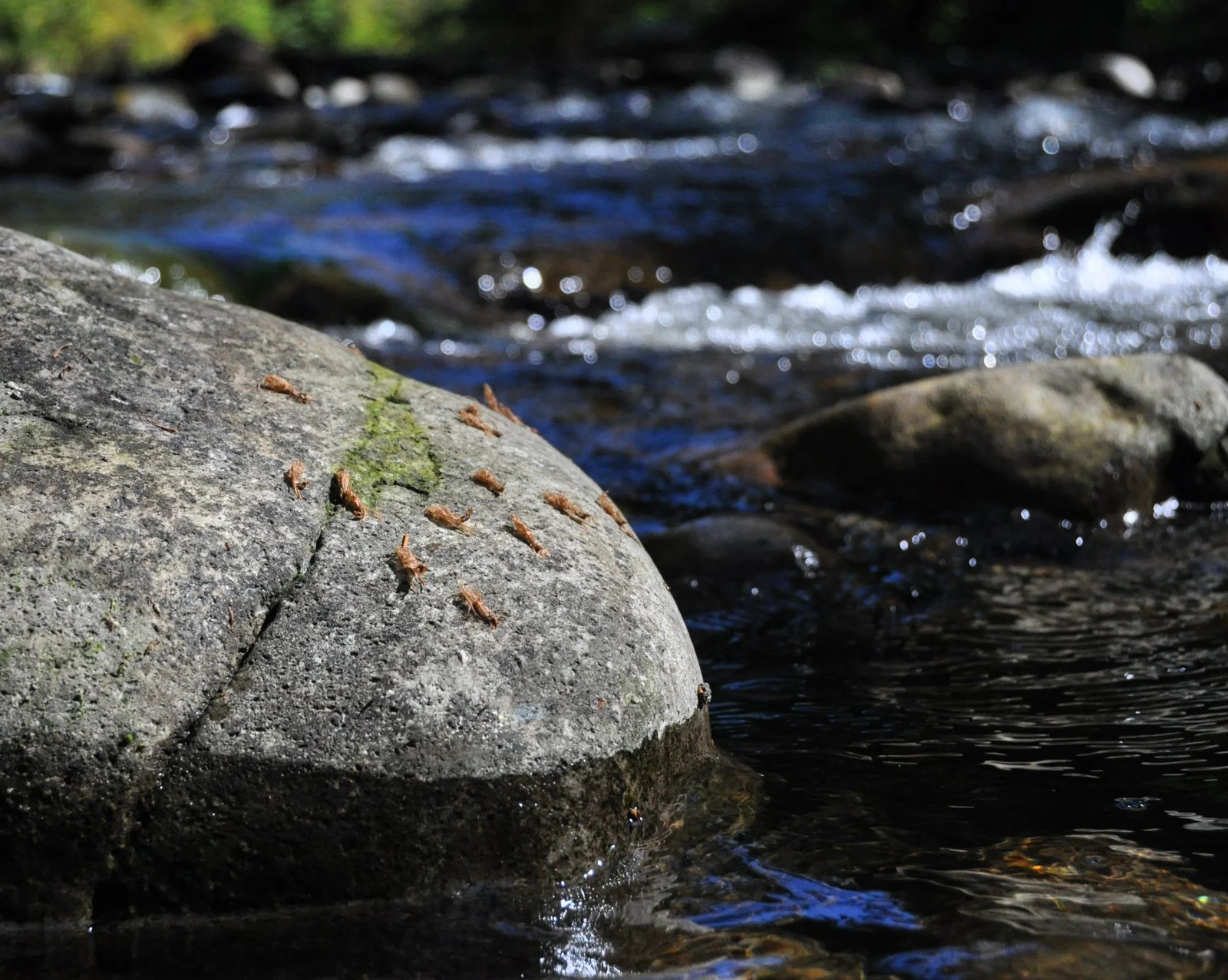
Marked safe from trout predation: sun-warmed river rock festooned with October Caddis.
Digging Into the Data: DRA Macroinvertebrate Monitoring
Now that we’ve covered the life history of the October Caddis, let’s take a look at what DRA’s macroinvertebrate monitoring data tells us about the presence and abundance of Dicosmoecus in the lower Deschutes River.
Unlike some of the insects we’ve featured in previous Bug of the Month posts, Dicosmoecus has never been particularly abundant in our samples. Since DRA monitoring began in 2015, it has been detected only occasionally and generally at low densities. One notable exception occurred at Kaskela in September 2016, when densities reached 26.9 individuals/m². More recently, Dicosmoecus was collected at Warm Springs in October 2025 at 13.45 individuals/m². Farther downstream, it was also detected at Maupin in May 2025 at 10.09 individuals/m² and at Rattlesnake Campground in May and October 2025 at 20.18 and 10.09 individuals/m², respectively.
Looking back at data collected before operation of the Selective Water Withdrawal Tower began in late 2009 provides some additional context. Dicosmoecus was also relatively uncommon in these historical samples. Most sites recorded no individuals during sampling in 2000 and 2001, although one downstream site contained 6 individuals/m² in May 2000 and another contained 1 individual/m². This suggests that October Caddis were naturally present at relatively low densities even before the SWW Tower began operating.
Because detections are sparse in both the pre- and post-tower datasets, there is not enough information to draw strong conclusions about how Dicosmoecus populations have changed over time. Still, their continued presence is worth watching. October Caddis are associated with cool, clean, well-oxygenated water and are considered sensitive to degraded water quality. Their scattered distribution and generally low abundance make long-term monitoring especially valuable: continued sampling can help us determine whether these occasional detections represent a stable population or whether their distribution and abundance in the lower Deschutes are changing over time.
Fly Patterns and Fishing Tips
Understanding the October Caddis life cycle gives anglers several opportunities to imitate this big fall bug. While the giant adult gets most of the attention, much of the action actually happens below the surface. That is especially true on the lower Deschutes, where, for reasons that aren't entirely clear, trout don't seem to key in on adult October Caddis as consistently as they do on many other western rivers. So, as tempting as it is to spend an October evening throwing giant orange dries, larval and pupal patterns may actually be your best bet.
Larval Imitations
October Caddis spend the vast majority of their lives as larvae crawling across the river bottom inside their protective cases. Although that case provides plenty of protection, larvae can still become dislodged and available to trout. This makes larval imitations worth fishing well before the fall hatch begins.
The natural larvae are big, so don't be afraid to fish a substantial fly. Orange, cream, tan, and yellow-orange patterns in roughly sizes #6–10 are good places to start. Weighted patterns are particularly useful for getting your imitation down where the naturals spend most of their time. The October Caddis Euro Nymph, large caddis larva patterns, or even a chunky orange-bodied nymph can all do the job
Fish these patterns close to the bottom through riffles, runs, and cobble-heavy water. A traditional indicator rig works well, but tight-line or Euro-style techniques can be particularly effective because they allow you to keep a heavily weighted fly right along the streambed. The goal isn't complicated: get it deep and keep it near the rocks.
Pupa Imitations
If there is one stage of the October Caddis life cycle that Deschutes anglers shouldn't overlook, it's the pupa. As fall approaches, mature pupae leave their cases and begin moving toward shore, often swimming or crawling along the bottom before climbing onto partially submerged rocks, logs, and other structure to emerge. During this migration, they lose the protection of their rocky cases and become a large, vulnerable meal.
This behavior also gives us a clue about where to fish. Rather than automatically casting toward the middle of the river, concentrate on the margins: the first few feet off the bank, soft water beside boulders and logs, seams between fast and slow water, and the edges of riffles and tailouts. These are natural travel corridors for pupae making their way toward shore.
Look for large pupa patterns in burnt orange, rusty orange, tan, or brown, generally in sizes #6–10. Dead-drift them near the bottom beneath an indicator, or try swinging an orange-bodied soft hackle or pupa down and across through likely water. At the end of the swing, let the fly hang and rise in the current for a few seconds. That movement can imitate a natural pupa swimming toward shore or beginning its emergence and can provoke a strike.
Adult Imitations
Here's where fishing the October Caddis on the lower Deschutes gets a little strange. On many western rivers, the appearance of these giant orange caddisflies can produce exciting fall dry-fly fishing. On the lower Deschutes, however, anglers can see plenty of adults along the river without seeing trout pay much attention to them. Why that happens isn't entirely clear, but it means the October Caddis dry-fly game here can be unpredictable.
That doesn't mean you shouldn't try. These are some of the biggest caddisflies of the year, and fishing a #6–10 dry fly in October is simply too much fun to pass up. Elk Hair Caddis-style patterns tied with a burnt-orange body and substantial deer or elk-hair wing are a good starting point. Adults tend to become more active later in the afternoon and toward dusk, so focus your dry-fly efforts during lower-light periods and around shaded banks, overhanging vegetation, boulders, and other streamside structure.
Start with a dead drift, but don't be afraid to break the usual dry-fly rules. October Caddis are big, awkward insects, and adults that end up on the water may flutter and struggle. An occasional twitch, hop, or controlled skate can make your imitation look much more convincing. If you've been throwing that big orange dry without so much as a look, take the hint from the trout and go subsurface. Try dropping an October Caddis pupa beneath your dry or switching entirely to a swung pupa or soft hackle.
That wraps up October’s Bug of the Month! While steelhead season may be closed on the lower Deschutes this year, that doesn’t mean you should put away the fishing gear just yet. Fall is one of the best times to be on the river, with cooler temperatures, fewer crowds, and plenty of opportunities to find a great campsite.
The steelhead closure is also difficult for the guides, shops, restaurants, and other local businesses that depend on anglers visiting the river. So, consider making a trip to Maupin, supporting a local business, or booking a trout trip with one of the local guides. There is still plenty of fun to be had on the Deschutes, even if it isn’t with a Spey rod in hand.
Stay tuned for our next featured bug in November, and until then, enjoy the cool weather, quiet river, and fall fishing.
More From The Blog



Subscribe the the DRA Newsletter
The Deschutes River Alliance is your focused voice to protect the lower Deschutes River, its cold water flows and the fish and wildlife that are sustained by them. We send regular emails with important data and news about the lower Deschutes River. We will not sell your contact information to others.
How to Support the DRA
Everyone wants clean, healthy water in the Deschutes River. Oregonians cherish our clean and healthy waterways to provide drinking water, wildlife habitat and recreational activities. The lower Deschutes River is a federally designated Wild & Scenic River, and a national treasure. It must be protected for the environmental and economic health of Central Oregon. By working together we can return the lower Deschutes River to full health.