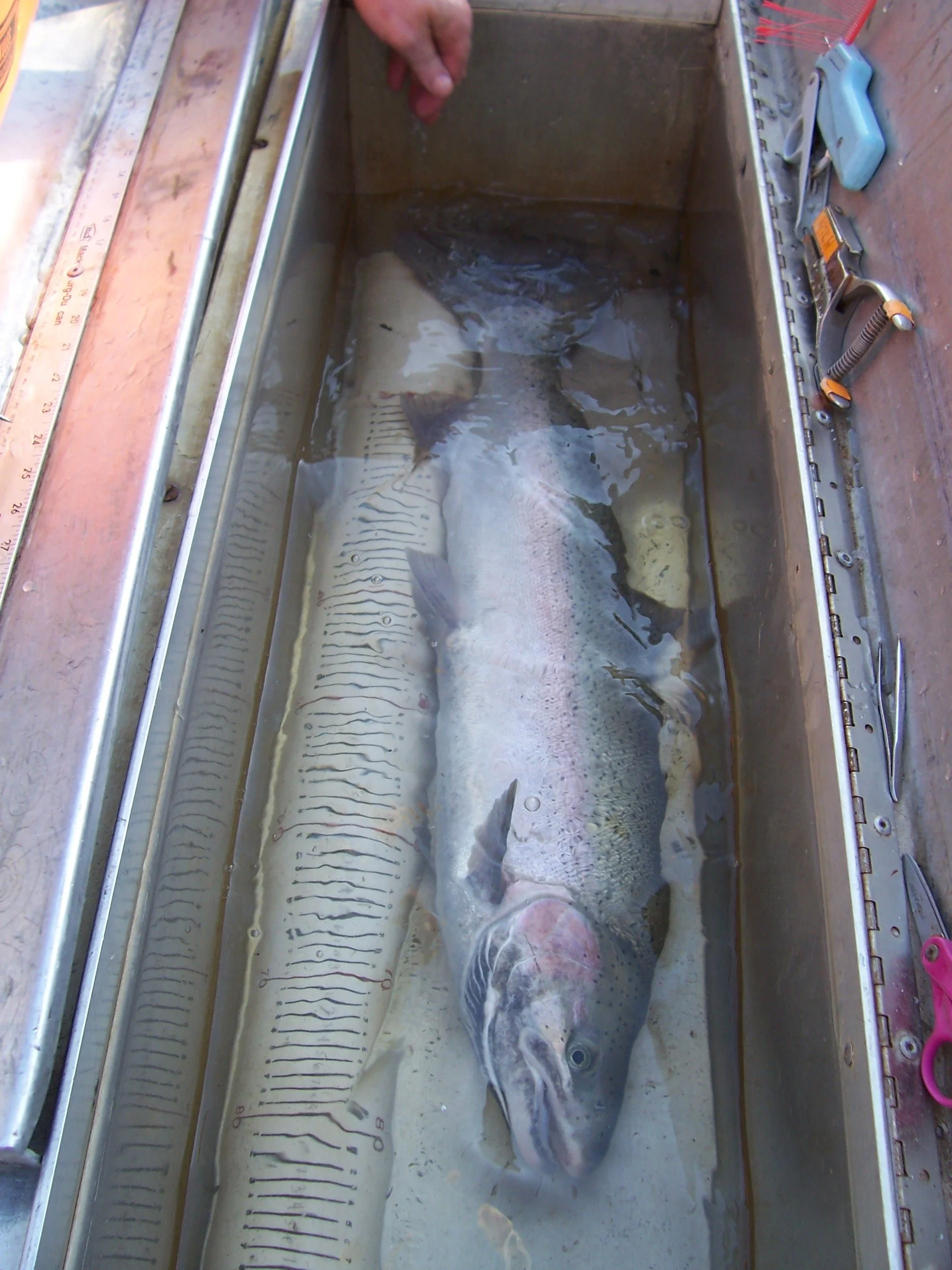
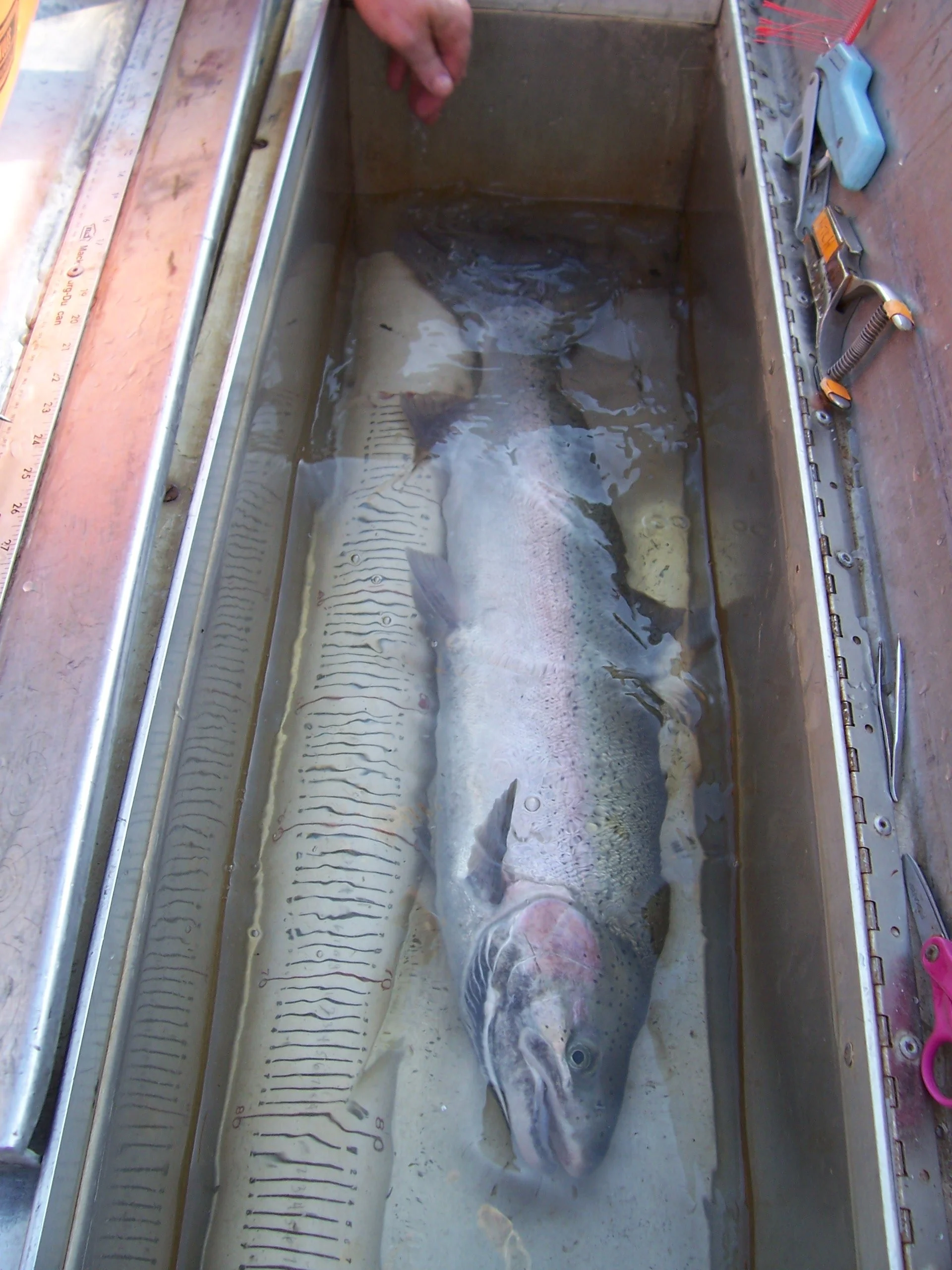
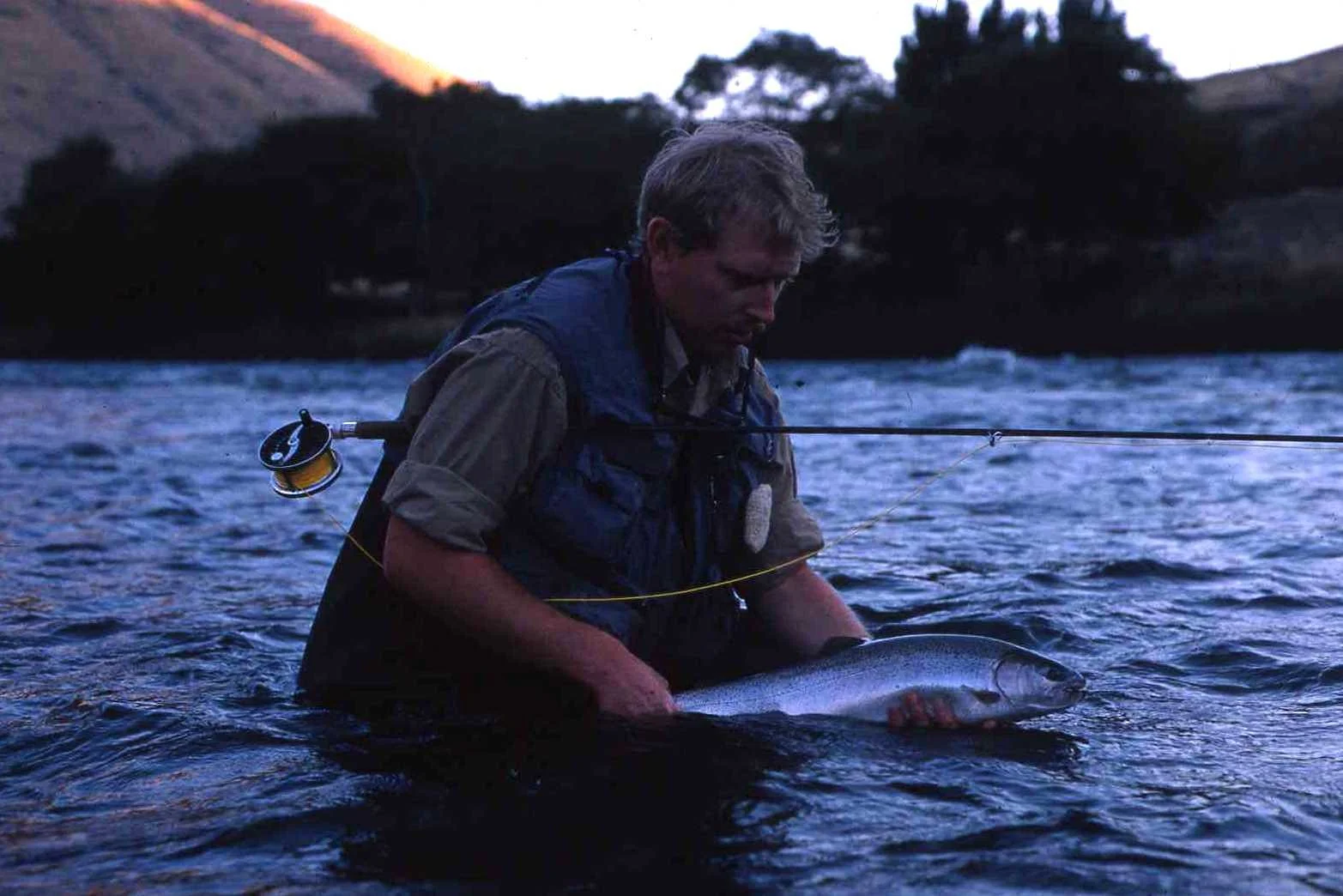
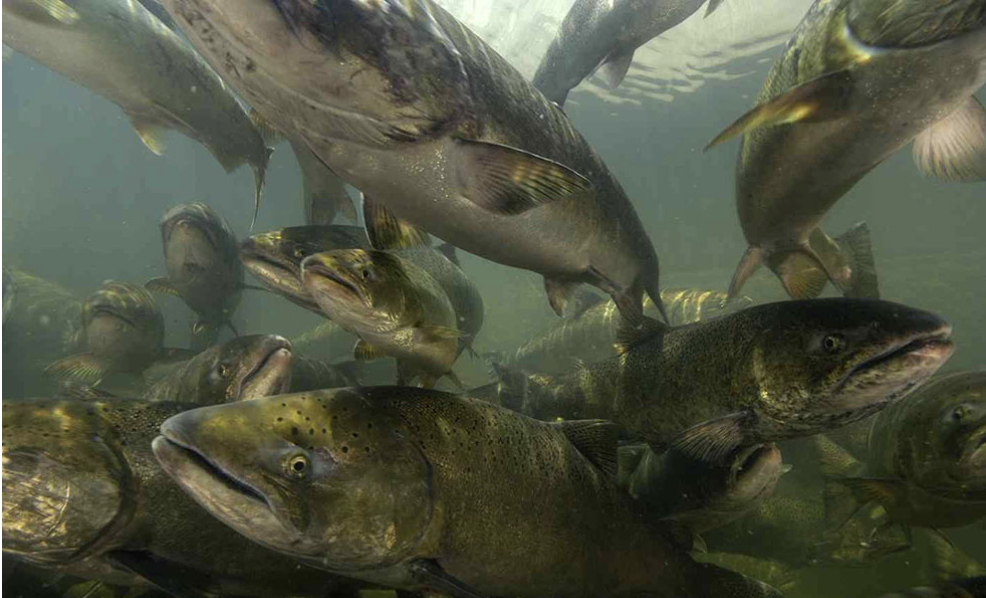
A steelhead undergoes a quick exam by ODFW.
Q. and A. With ODFW’s Jason Seals, Part 2
DRA: What can anglers do to help achieve more wild steelhead in the Deschutes?
As mentioned, anglers should harvest hatchery steelhead they catch to reduce risk to wild steelhead within the Deschutes. Decades of our angler survey data estimates that about 30% of the hatchery steelhead that are captured in the Deschutes steelhead fishery are released. There seems to be an inclination by some anglers that releasing these hatchery steelhead is beneficial. However, it’s the opposite, harvesting hatchery steelhead in the Deschutes reduces the risks associated with hatchery steelhead spawning interactions with wild steelhead such as dilution of local adaptation which can create lower reproductive success.
However possible, support national, regional, and international policies, actions, and programs that work to minimize ocean warming, ocean acidification, and ocean trophic ecology impacts.
Support fish passage initiatives throughout the Columbia River basin. Steelhead need broad and volitional access through the Columbia-Snake River mainstem and tributaries to be able to disperse and adjust to variable environmental conditions.
Anglers can support water conservation initiatives from ODFW and partners in the Deschutes, John Day, Umatilla and Grande Ronde River Basins. The old saying that fish need water to survive is very simple but so accurate for wild steelhead in these basins. Many of the Middle Columbia steelhead sub-basins including, but not limited to, the John Day and tributaries, Trout Creek, Crooked River and Fifteenmile Creek are overallocated for irrigation water.
Contribute in whatever way possible to support habitat restoration projects and land acquisitions throughout the interior Columbia River basin. Numerous agencies and tribes are working to improve fish passage, habitat, water quality and quantity to produce more wild steelhead. If you recall our statement that the majority of steelhead caught in Deschutes River fisheries are ‘temporary strays’, habitat projects that are not located in the Deschutes basin will ultimately contribute adult steelhead to future Deschutes River fisheries (here is one example: https://www.youtube.com/watch?v=ReTkmqMd6ko).
Finally, recognize the importance of all angler types because we’re in this together and at the end of the day everyone wants more fish in our rivers. Everyone has different preferences on how to fish and what to fish for, but recognizing and supporting those preferences will keep anglers united for more fish and fishing in the future.
DRA: The DRA has monitored water quality in the lower Deschutes River since 2016, logging thousands of violations of state water quality standards. What data exist to demonstrate impacts of these water quality violations to steelhead migrating through or living in the mainstem Deschutes River?
As you know, ODFW does not regulate or monitor water quality in the state. Our job, along with others such as the Confederated Tribes of the Warm Springs, is to monitor fish populations, manage fisheries, determine what may or may not be affecting these populations if declines are observed, and work with entities such as PGE and ODEQ for improvements.
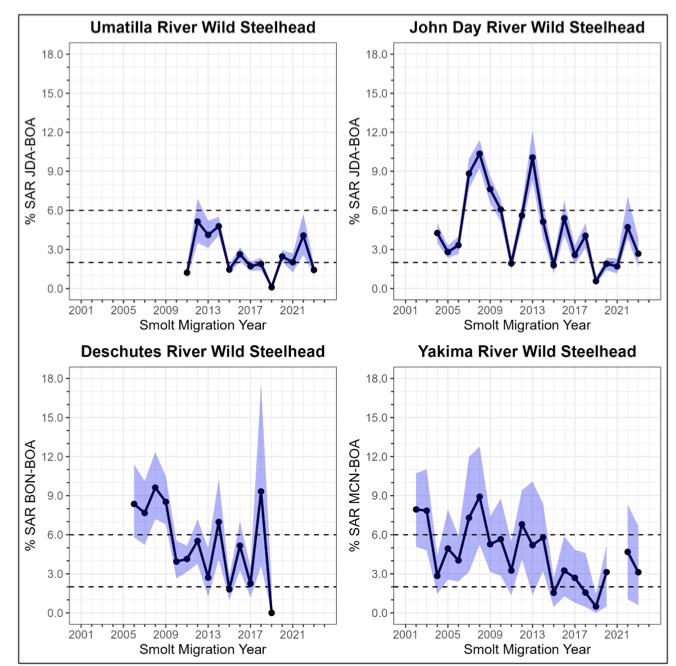
Regarding steelhead in the Deschutes, we're able to annually estimate adult steelhead abundance upstream of Sherars Falls and monitor various metrics of resident Redband Trout. As mentioned previously, there are many things influencing the success of steelhead throughout their life-history from being a juvenile in the Deschutes to juvenile emigration to ocean survival and back through the Columbia River, etc.
Since the start of the PGE Selective Water Withdrawal in 2010, we felt the best proxy to evaluate effects within the mainstem Deschutes for steelhead rearing was to examine metrics from Redband Trout such as annual growth, maximum growth, coefficient of body condition, and densities. Redband Trout are the resident form of steelhead in the Deschutes, directly related (sometimes sharing the same parent), and share the same habitat and diet. We can evaluate these recent data and compare baselines from other decades (1970s, 80s, and 90s) of Redband Trout research and monitoring.
Without going too deep into the weeds of these data, we don’t have evidence to suggest that there is measurable change in the resident trout post-2010; thus, inferring growth and survival of steelhead juveniles is likely similar to pre-SWW. This doesn’t mean that the Pelton-Round Butte complex does not have impacts on steelhead in the basin, but it does mean we don’t have evidence that rearing conditions have changed to their detriment. The graph below illustrates density plots of Redband Trout at our index sites near North Junction and downstream of Nena Creek. While there is considerable annual variability, recent estimates of trout densities are very similar to historic estimates at the same locations. In conjunction to this work, we are also conducting a study to evaluate the bioenergetics of Redband Trout and juvenile Fall Chinook in the Deschutes, which should help determine if O. mykiss in the mainstem Deschutes are feeding at optimal rates (or not) based on diet available.
Next week: Part 3 of Q. and A. With Jason Seals.
More From The Blog
Subscribe the the DRA Newsletter
The Deschutes River Alliance is your focused voice to protect the lower Deschutes River, its cold water flows and the fish and wildlife that are sustained by them. We send regular emails with important data and news about the lower Deschutes River. We will not sell your contact information to others.
How to Support the DRA
Everyone wants clean, healthy water in the Deschutes River. Oregonians cherish our clean and healthy waterways to provide drinking water, wildlife habitat and recreational activities. The lower Deschutes River is a federally designated Wild & Scenic River, and a national treasure. It must be protected for the environmental and economic health of Central Oregon. By working together we can return the lower Deschutes River to full health.